
Worksheet
A Diary Page from 1895
A diary entry helps kindergarten students compare toys, school, chores, clothing, and travel long ago and today.
KindergartenSocial StudiesInteractive · Printable
Aligned toHIS.K.2
What’s included
- Single worksheet
- Auto-graded online
- 1 C3 Framework standard
- Printable answer key
- 10 questions
- Classroom-ready
Details
- Format
- Interactive · Printable
- Grade
- Kindergarten
- Subject
- Social Studies
- Question types
- Fill in the blank, Multiple choice, Matching, Circle the answer, Sorting, Short answer
About this worksheet
What students practice
- Students compare toys, school tools, chores, clothing, and travel long ago and today.
- Students use details from a diary entry to describe one change between past and present.
How to use
Read the diary aloud and talk about each detail. Then help students compare the past and today before they answer.
Curriculum
C3 Framework standard covered
Compare how children lived long ago with today: toys, school, chores, clothing and travel.
Preview
OwlSheets.com
A Diary Page from 1895
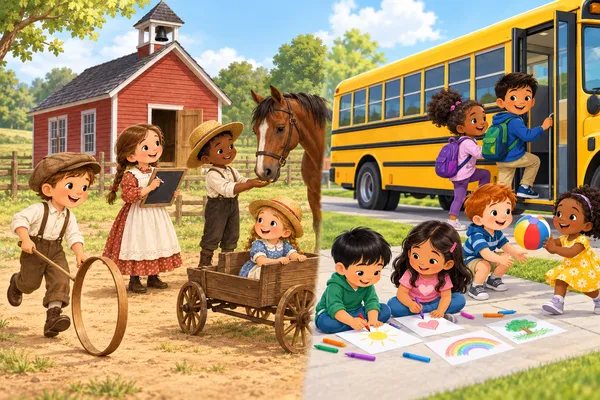
Compare a child's life long ago with life today.
Read the diary
Listen as your teacher reads the diary. Then answer the questions.
A Diary Page from 1895
October 4, 1895. Dear Diary, Today I walked to my one-room schoolhouse. I wrote on a slate with chalk. At recess, my friends and I rolled wooden hoops. After school, I carried water and helped feed our horse. I wore a wool dress and boots. Our family traveled in a horse-drawn wagon. The diary ends here. Today, many children use paper and pencils at school, play with balls, help with different chores, wear many kinds of clothes, and travel by car or bus.
- A. Paper and pencils
- B. A ball and a book
- C. A slate and chalk
- D. A car or bus
- Long-ago toy
- Long-ago school tool
- Long-ago way to travel
- A. A slate and chalk
- B. A horse-drawn wagon
- C. A wooden hoop
After school, the child helped feed the .
The child wore a wool dress and boots.The child carried water after school.Many children use paper and pencils today.Many children travel by car or bus today.
- A. Slate and chalk; paper and pencils
- B. Wooden hoop; balls
- C. Wool dress and boots; car or bus
- D. Horse-drawn wagon; one-room schoolhouse
Compare long ago and today
Think about the diary. Sort, circle, and tell how life changed.
| Long ago (1895) | Today |
|---|---|
- A. Children in both times helped with chores.
- B. Children in both times used a slate and chalk.
- C. Children long ago traveled by car or bus.
- D. Children today traveled in a horse-drawn wagon.
Long ago, the child wrote on a slate; today, many use paper and pencils.Long ago, the family used a horse-drawn wagon; today, many use a car or bus.Children in both times went to school.Children in both times helped with chores.
- A. Children used the same toys and school tools in both times.
- B. Children long ago went to school, but they did not do chores.
- C. Some things changed, while children in both times played and helped with chores.
- D. Children today traveled and dressed just like the diary child did.
Related worksheets
 Worksheet
Kindergarten
Elise's Maple-Sap Letter
History · HIS.K.4
Free10 questions
 Worksheet
Kindergarten
A Timeline of American Holidays
History · HIS.K.3
Premium10 questions
 Worksheet
Kindergarten
Days at the Old Icehouse
History · HIS.K.1
Premium10 questions
 Worksheet
Kindergarten
Clara's Letter from Railroad Day
History · HIS.K.1
Free10 questions
 Worksheet
Kindergarten
Holiday Windows: Then and Now
History · HIS.K.3
Free9 questions
 Worksheet
Kindergarten
A Quilt Timeline for Spring
History · HIS.K.4
Premium10 questions