Grade 4 · Social StudiesCIV.4.1
The Stadium Operations Map
Use a stadium-area map and operations packet to compare local, state, and national government responsibilities and services.
Preview
OwlSheets.com
The Stadium Operations Map
Use a stadium-area map to compare three levels of government.

Read the operations packet
Read the packet for a fictional championship in Rookhaven. Use both the map description and the service information to answer.
Six Places Around Rookhaven Stadium
Rookhaven is a fictional US city preparing for a sports championship. The city owns the stadium, but private businesses sell food and broadcast the game. Organizers collect a map and service notes in an operations packet. The packet describes government responsibilities for this event.
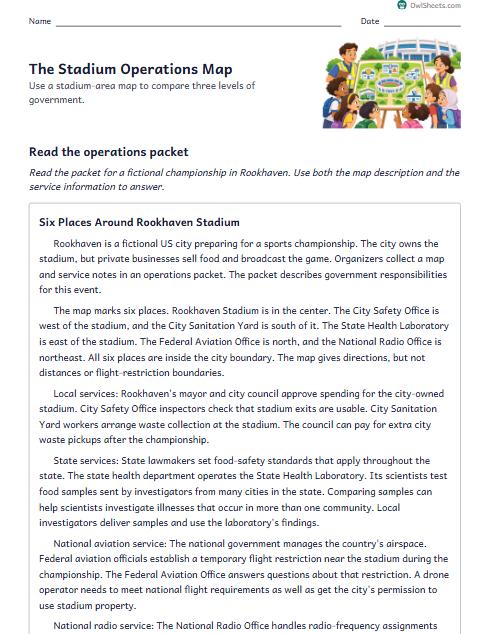
The map marks six places. Rookhaven Stadium is in the center. The City Safety Office is west of the stadium, and the City Sanitation Yard is south of it. The State Health Laboratory is east of the stadium. The Federal Aviation Office is north, and the National Radio Office is northeast. All six places are inside the city boundary. The map gives directions, but not distances or flight-restriction boundaries.
Local services: Rookhaven's mayor and city council approve spending for the city-owned stadium. City Safety Office inspectors check that stadium exits are usable. City Sanitation Yard workers arrange waste collection at the stadium. The council can pay for extra city waste pickups after the championship.
State services: State lawmakers set food-safety standards that apply throughout the state. The state health department operates the State Health Laboratory. Its scientists test food samples sent by investigators from many cities in the state. Comparing samples can help scientists investigate illnesses that occur in more than one community. Local investigators deliver samples and use the laboratory's findings.
National aviation service: The national government manages the country's airspace. Federal aviation officials establish a temporary flight restriction near the stadium during the championship. The Federal Aviation Office answers questions about that restriction. A drone operator needs to meet national flight requirements as well as get the city's permission to use stadium property.
National radio service: The National Radio Office handles radio-frequency assignments for broadcasters across the United States. These assignments help keep broadcasts from interfering with one another. A private broadcasting company covers the game and sells advertising. The company, not the government radio office, decides its advertising prices.
- A. North, because federal aviation officials inspect stadium buildings.
- B. West, because city inspectors check stadium exits.
- C. South, because city waste workers inspect stadium buildings.
- D. East, because the state laboratory checks stadium exits.
- A. The city checks building exits; the state assigns broadcast frequencies.
- B. The city tests food samples; the state arranges stadium waste pickups.
- C. The city checks building exits; the state tests food samples.
- D. The city sets statewide food standards; the state checks building exits.
- A. It can assign both cities' waste collections to Rookhaven's workers.
- B. It can let each event choose a different statewide food standard.
- C. It can replace each city's stadium exit inspection with a food test.
- D. It can compare samples to investigate a problem affecting both cities.
The laboratory is east of the stadium.The stadium belongs to the city.Investigators from many cities send samples to the laboratory.Federal officials answer questions about a flight restriction.
- A. The city council's property permission changes the national flight restriction.
- B. The operator must also meet the national requirements for using airspace.
- C. The national radio office's broadcast assignment supplies the flight permission.
- D. The state laboratory must approve the flight before the city gives permission.
- A. Ask the national radio office about signal assignments and the private broadcaster about advertising prices.
- B. Ask the private broadcaster about signal assignments and the national radio office about advertising prices.
- C. Ask the city council about signal assignments and the state laboratory about advertising prices.
- D. Ask the federal aviation office about signal assignments and the city council about advertising prices.
- A. No; the packet assigns that stadium service to the city.
- B. Yes; national attendance transfers the stadium's services to federal offices.
- C. No; the visitors' home states take turns collecting stadium waste.
- D. Yes; visitors' home addresses determine who collects stadium waste.
Test the organizers' plans
Apply the packet to these new situations. Consider each government's job, not just where its office is located.
- A. City food standards replace state standards; one state waste schedule applies.
- B. Each seller chooses food standards; national officials arrange both waste schedules.
- C. State food standards apply at both events; city waste schedules can differ.
- D. National food standards replace the state's; Rookhaven collects both cities' waste.
- A. The decision funds a city service, not changes to the state's laboratory work.
- B. The council's decision transfers food testing to the stadium's private sellers.
- C. The laboratory's location makes it part of the city's waste collection service.
- D. The extra pickups give federal aviation officials control of the laboratory.
Pay for repairs that make the city stadium's exits usable.Replace the state's food-safety standards with a championship rule.Cancel the national flight restriction above the stadium.Arrange an additional waste pickup after the final game.
- A. Treat the city boundary as the edge of the national flight restriction.
- B. Ask federal aviation officials, since the map does not show the restriction's edge.
- C. Use the laboratory's position to mark where state-controlled airspace begins.
- D. Measure from the aviation office to estimate the flight restriction's edge.
- A. It is supported because a city inspection replaces testing at a state facility.
- B. It is unsupported because food-sample testing belongs to national aviation officials.
- C. It is supported because both offices appear inside the same city boundary.
- D. It is unsupported because the two services examine different kinds of safety.
Related worksheets
Before the First Ballot: Two Election Jobs
Grade 4 · CIV.4.1
14 questionsPremium
Bellwake Island's Service Records
Grade 4 · CIV.4.1
14 questionsPremium
One Flood, Three Governments
Grade 4 · CIV.4.1
13 questionsPremium
Three Parks, Three Governments
Grade 4 · CIV.4.1
13 questionsPremium
Market Day, Three Government Roles
Grade 4 · CIV.4.1
13 questionsPremium
Three Levels, One Neighborhood
Grade 4 · CIV.4.1
14 questionsPremium