Grade 4 · Social StudiesGEO.4.2Premium
Two Mountain Towns, Five Regions
Compare two fictional mountain towns and use regional descriptions to check claims about U.S. landforms, climate, and natural resources.
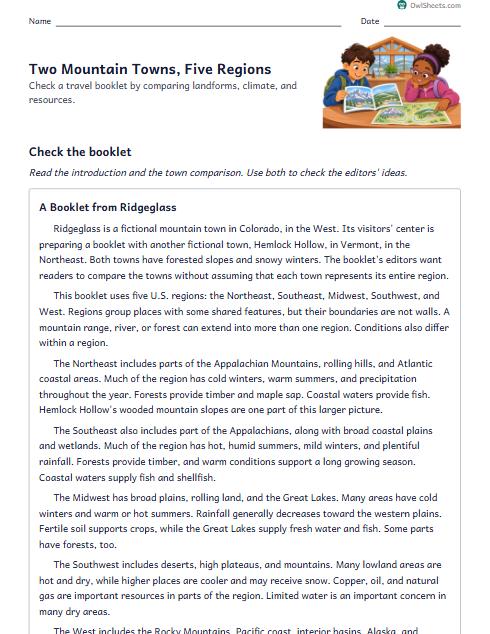
Preview
OwlSheets.com
Two Mountain Towns, Five Regions
Check a travel booklet by comparing landforms, climate, and resources.
Check the booklet
Read the introduction and the town comparison. Use both to check the editors' ideas.
A Booklet from Ridgeglass
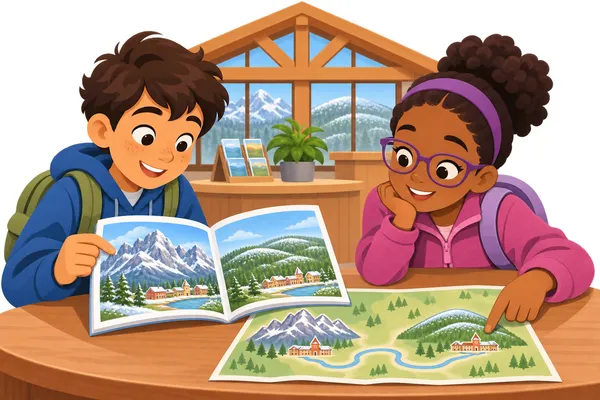
Ridgeglass is a fictional mountain town in Colorado, in the West. Its visitors' center is preparing a booklet with another fictional town, Hemlock Hollow, in Vermont, in the Northeast. Both towns have forested slopes and snowy winters. The booklet's editors want readers to compare the towns without assuming that each town represents its entire region.
This booklet uses five U.S. regions: the Northeast, Southeast, Midwest, Southwest, and West. Regions group places with some shared features, but their boundaries are not walls. A mountain range, river, or forest can extend into more than one region. Conditions also differ within a region.
The Northeast includes parts of the Appalachian Mountains, rolling hills, and Atlantic coastal areas. Much of the region has cold winters, warm summers, and precipitation throughout the year. Forests provide timber and maple sap. Coastal waters provide fish. Hemlock Hollow's wooded mountain slopes are one part of this larger picture.
The Southeast also includes part of the Appalachians, along with broad coastal plains and wetlands. Much of the region has hot, humid summers, mild winters, and plentiful rainfall. Forests provide timber, and warm conditions support a long growing season. Coastal waters supply fish and shellfish.
The Midwest has broad plains, rolling land, and the Great Lakes. Many areas have cold winters and warm or hot summers. Rainfall generally decreases toward the western plains. Fertile soil supports crops, while the Great Lakes supply fresh water and fish. Some parts have forests, too.
The Southwest includes deserts, high plateaus, and mountains. Many lowland areas are hot and dry, while higher places are cooler and may receive snow. Copper, oil, and natural gas are important resources in parts of the region. Limited water is an important concern in many dry areas.
The West includes the Rocky Mountains, Pacific coast, interior basins, Alaska, and Hawaii. Its climates range from cold Arctic conditions to tropical warmth, with wet coastal areas and dry interiors between them. Resources include forests, fish, minerals, and fertile valley soils. Ridgeglass provides a close look at a Rocky Mountain setting, not at every western landscape.
| Feature | Ridgeglass, Colorado | Hemlock Hollow, Vermont |
|---|---|---|
| Landforms | High, steep Rocky Mountain slopes | Lower, rounded Appalachian slopes |
| Typical January | Cold and snowy | Cold and snowy |
| Typical July | Mild; fairly dry | Warm; rain is common |
| Local resources | Forest timber; building stone | Forest timber; maple sap |
- A. Their summers match, but their winter conditions differ.
- B. Their winters are similar, but their summer conditions differ.
- C. Their resources differ, so their winter conditions differ.
- D. Their landforms match, so their climates probably match.
The preview shows the first questions. Unlock the worksheet to see all of it.
Related worksheets
The Lighthouse Geography Relay
Grade 4 · GEO.4.2
14 questionsPremium
Where the Cargo Began
Grade 4 · GEO.4.2
14 questionsPremium
A Five-Region Audio Tour
Grade 4 · GEO.4.2
14 questionsFree
Regional Notes from Willowbend
Grade 4 · GEO.4.2
15 questionsPremium
The Five-Region Harvest Guide
Grade 4 · GEO.4.2
15 questionsPremium

Choosing the Festival's First Connection
Grade 4 · GEO.4.1
14 questionsPremium