Grade 4 · Social StudiesGEO.4.2Premium
Where the Cargo Began
Read a dockworker's letter and evaluate cargo-origin labels using evidence about five US regions' landforms, climates, and resources.
Preview
OwlSheets.com
Where the Cargo Began
Use a dockworker's letter to compare five US regions.
Read the letter
Read Ren's letter. Choose answers supported by the regional descriptions.
A Letter from Morrowquay Export Pier
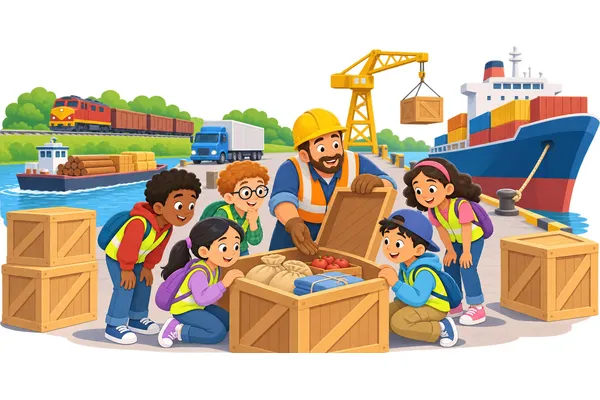
Dear apprentice, Welcome to our export pier! Cargo ships carry goods overseas, but much of our cargo begins far inland. Trains, trucks, and river barges bring it here. Before making origin labels, read these notes about five US regions. Natural resources come from nature; workers turn some of them into products.
The Northeast has rocky hills, parts of the Appalachian Mountains, and an Atlantic coastline. Winters are generally cold, and precipitation falls throughout the year. Forests provide timber. Sap from maple trees becomes maple syrup, one cargo stored here. Granite is another resource, although this week's ships are not carrying it.
The Southeast includes broad, low coastal plains and southern parts of the Appalachians. Much of the region has hot, humid summers and milder winters than the Northeast. Pine forests supply timber. Florida has large phosphate deposits, which are mined and used to make fertilizer. Coastal waters also provide fish and shellfish.
The Midwest includes wide plains, rolling hills, and the Great Lakes. Many places have warm summers and cold winters. Fertile soil supports fields of corn and soybeans. Iron ore is mined near Lake Superior. Our Midwest shipments include grain and steel products made from iron ore. They reached this ocean port by rail.
The Southwest includes deserts, high plateaus, canyons, and mountains. Much of it receives little precipitation. Many low places have very hot summers, while higher places are cooler. Copper deposits supply metal for wire. Oil and natural gas are other resources. A copper shipment tells us about a mineral resource, not how much rain fell where it was mined.
The West includes high mountain ranges, valleys, deserts, and Pacific coastlines. Its climates differ greatly: parts of the Pacific Northwest are moist, while many inland areas are dry. Forests supply timber, and Pacific waters supply fish. Alaska and Hawaii are included in this five-region system, adding cold northern and tropical settings.
These are broad descriptions, not promises about every place. A forest shipment does not tell us whether its trees grew on hills or low plains. An empty cargo space does not prove a region lacks that resource. Our pier's cargo changes each week. Your labels should describe the cargo's origin without turning one shipment into a description of a whole region. Sincerely, Ren Ellis, cargo clerk
- A. Describe the port's climate as the climate of the cargo's origin.
- B. Describe where the resources began, including places far inland.
- C. Group the shipments by their arrival dates rather than their origins.
- D. Group the shipments by ship size rather than their starting places.
- A. Southwest: wire from mined copper
- B. Midwest: grain from broad plains
- C. Southeast: fertilizer from phosphate
- D. Northeast: syrup from forest resources
The preview shows the first questions. Unlock the worksheet to see all of it.
Related worksheets
The Lighthouse Geography Relay
Grade 4 · GEO.4.2
14 questionsPremium
Two Mountain Towns, Five Regions
Grade 4 · GEO.4.2
14 questionsPremium
A Five-Region Audio Tour
Grade 4 · GEO.4.2
14 questionsFree
Regional Notes from Willowbend
Grade 4 · GEO.4.2
15 questionsPremium
The Five-Region Harvest Guide
Grade 4 · GEO.4.2
15 questionsPremium
Choosing the Festival's First Connection
Grade 4 · GEO.4.1
14 questionsPremium