← Exit

Two Proposals from Granite Gap

0 / 13

Two Proposals from Granite Gap

Compare two fictional bills as they move through Congress.

Compare the Records

Read the guide and the fictional records. Circle one answer for each multiple-choice question.

Mountain Ideas, National Decisions

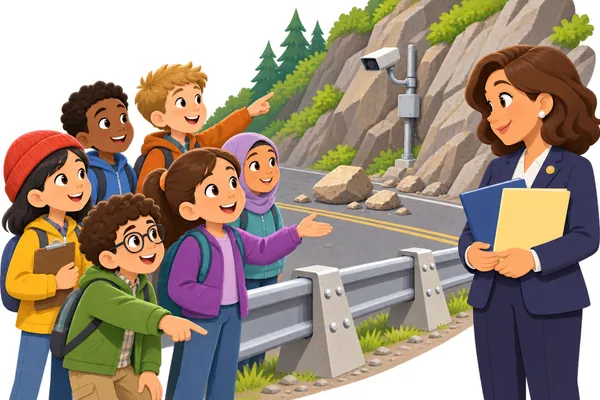
Granite Gap is a fictional mountain town beside a federal road. Falling rocks sometimes block the road after heavy rain. Residents discuss two possible projects: detectors that warn drivers when rocks fall, and stronger barriers that catch rocks beside the road. They send their ideas to members of the United States Congress. The two bills and their records below are made up for practice.

A bill is a proposed law. A resident can suggest an idea, but a member of Congress formally introduces a bill. Congress has two chambers: the House of Representatives and the Senate. These project bills begin in the House, although many bills can begin in either chamber.

After introduction, a committee studies a bill closely. Committee members may hear from people with useful information, suggest changes, and decide whether to send the bill to the full chamber. The full chamber can debate the proposal and vote. Committee approval is a step toward that vote, not a replacement for it.

A bill that passes one chamber still needs approval from the other. The second chamber also reviews and votes on it. Both chambers must pass exactly the same wording before the bill goes to the president. If one chamber changes the wording, more work and votes may be needed.

The president can sign a bill into law or veto it. A veto returns the bill to Congress with the president's objections. Congress can try to override, or overcome, the veto. That requires a two-thirds vote in each chamber. A large enough vote in one chamber does not replace the required vote in the other. The records below follow bills whose presidents either signed or vetoed them; they do not show every possible outcome.

Fictional Federal Bill Records: Listed in Order
StageDetector BillBarrier Bill
IntroductionA House member introduces it.A House member introduces it.
House committeeHears engineers; sends bill forward.Studies costs; sends bill forward.
Full HouseDebates and passes it.Debates and passes it.
SenateReviews and passes the same wording.Reviews and passes the same wording.
PresidentSigns the bill.Vetoes the bill.
Override votesNo override vote needed.House reaches 2/3; Senate below 2/3.
1.
Which comparison best explains why the two bills had different outcomes?
Question 1 options
2.
A reporter leaves the committee stage out of both records. Which part of the work would readers miss?
Question 2 options
3.
Circle TWO record details that together explain why the Barrier Bill did not become law.

4.
Imagine the records ended just after the full House votes. Which report would be accurate at that point?
Question 4 options
5.
Compare what happened to the two bills. Sort each description using the records.
6.
Which single change to the Barrier Bill's final record would have made its override successful?
Question 6 options
7.
Were the two bills equally far along just before they reached the president? Make a claim and support it with two details from the records. Explain why those details matter.

Check New Cases

Use the guide to check these new fictional cases. Each case is separate from the two bill records.

8.
A Granite Gap resident writes a detailed proposal for federal rockfall research and mails it to a senator. Which detail would show that it had become a bill formally before Congress?
Question 8 options
9.
A federal bridge inspection bill begins in the Senate. After committee review, the full Senate passes it. Which step fits its path next?
Question 9 options
10.
A student writes this process log: “A House member introduces a bill. The full House passes it. A House committee then studies it before its first full House vote.” Which correction fixes the order?
Question 10 options
11.
A new federal road bill has reached a committee. Circle TWO actions that fit the committee's job before it sends the bill forward.

12.
A student argues, “The president decides whether a vetoed bill becomes law.” Which statement most accurately corrects this claim?
Question 12 options
13.
Someone says, “Studying costs and hearing from engineers are enough to make a road proposal a law.” Explain why careful study matters but is not enough. Use the guide and at least one of the two bill records as evidence.