Grade 4 · Social StudiesECO.4.2
Rolling into a Price Decision
Use a desert-city roller rink story and customer survey to explain how supply, demand, and prices affect one another.
Preview
OwlSheets.com
Rolling into a Price Decision
Study a family roller rink's choices about rental prices.
A Busy Week at the Rink
Read the fictional story. Choose answers supported by the story and the economics ideas it explains.
Skates for the Afternoon
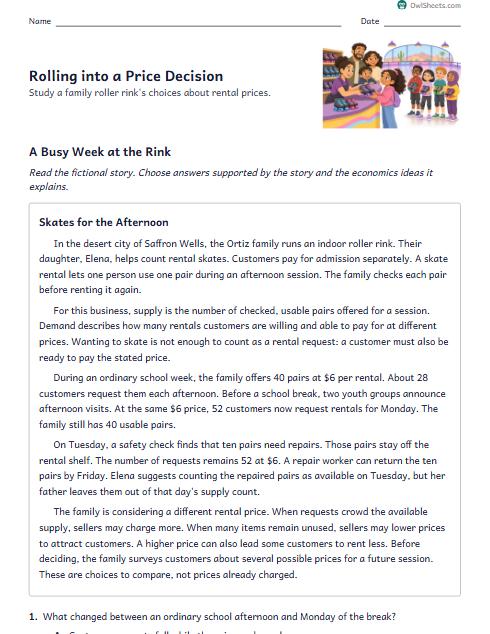
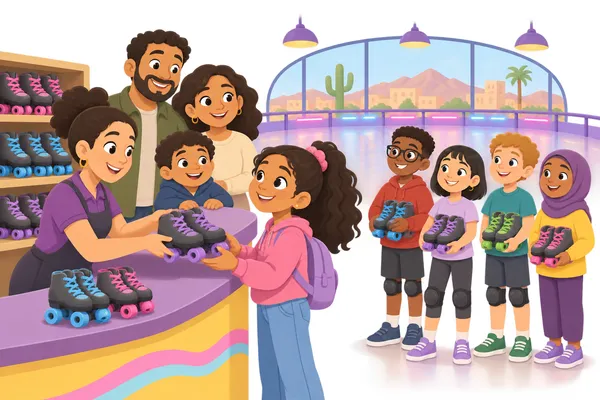
In the desert city of Saffron Wells, the Ortiz family runs an indoor roller rink. Their daughter, Elena, helps count rental skates. Customers pay for admission separately. A skate rental lets one person use one pair during an afternoon session. The family checks each pair before renting it again.
For this business, supply is the number of checked, usable pairs offered for a session. Demand describes how many rentals customers are willing and able to pay for at different prices. Wanting to skate is not enough to count as a rental request: a customer must also be ready to pay the stated price.
During an ordinary school week, the family offers 40 pairs at $6 per rental. About 28 customers request them each afternoon. Before a school break, two youth groups announce afternoon visits. At the same $6 price, 52 customers now request rentals for Monday. The family still has 40 usable pairs.
On Tuesday, a safety check finds that ten pairs need repairs. Those pairs stay off the rental shelf. The number of requests remains 52 at $6. A repair worker can return the ten pairs by Friday. Elena suggests counting the repaired pairs as available on Tuesday, but her father leaves them out of that day's supply count.
The family is considering a different rental price. When requests crowd the available supply, sellers may charge more. When many items remain unused, sellers may lower prices to attract customers. A higher price can also lead some customers to rent less. Before deciding, the family surveys customers about several possible prices for a future session. These are choices to compare, not prices already charged.
- A. Customer requests fell while the price and supply grew.
- B. The supply grew while customer requests stayed the same.
- C. The rental price rose while the supply stayed the same.
- D. Customer requests grew while the price and supply stayed the same.
- A. The number of usable pairs will grow with the requests.
- B. Some usable pairs will remain on the rental shelf.
- C. The family will have enough pairs for the requests.
- D. Some customers requesting skates will not get a pair.
The rental price stayed at $6.Customers paid admission separately.Some skates needed a safety repair.Requests increased from 28 to 52.
- A. It treats the rental price as the number supplied.
- B. It includes pairs not ready to rent that afternoon.
- C. It counts customer requests instead of usable pairs.
- D. It leaves out pairs used during the school week.
- A. It adds upward pressure because more requests compete for each usable pair.
- B. It adds downward pressure because fewer skates are usable.
- C. It adds downward pressure because repairs count as extra rentals.
- D. It removes price pressure because customer requests are unchanged.
- A. Count it as a paid request at the stated price.
- B. Treat it as interest, not a rental request at that price.
- C. Treat it as proof that the supply has decreased.
- D. Count it as an extra pair in the rental supply.
At the Price Desk
Use the survey for Questions 7–9. Then apply supply-and-demand ideas to new situations at the rink.
| Price per rental | Pairs requested | Pairs available |
|---|---|---|
| $4 | 60 | 40 |
| $6 | 44 | 40 |
| $8 | 30 | 40 |
At $8, customers request fewer pairs than at $4.
- A. $8, because the highest price fills the most pairs.
- B. $4, because requests exceed supply by the greatest amount.
- C. $6, because requests still exceed supply at that price.
- D. $8, because fewer requests leave room for more rentals.
- A. Supply rises to 44; the higher price creates four usable pairs.
- B. Supply stays at 40; the higher price reduces requests to 30.
- C. Supply stays at 40; the higher price increases requests to 60.
- D. Supply falls to 30; the higher price leaves requests at 44.
- A. Downward pressure, because fewer customers are requesting skates.
- B. Upward pressure, because fewer customers are requesting skates.
- C. Upward pressure, because canceling a visit removes usable pairs.
- D. Downward pressure, because canceling a visit adds usable pairs.
A nearby rink closes, sending more renters to the Ortiz rink.A delivery of new, checked skates expands the usable supply.A broken storage lock keeps several usable pairs out of reach.A competing rink opens, drawing away some rental customers.
- A. The two increases are likely to cancel because both happened together.
- B. Prices are likely to rise because requests matter more than supply.
- C. She needs the sizes of both increases to judge the price pressure.
- D. Prices are likely to fall because supply matters more than requests.
- A. The usable pairs and customer requests before the price decision
- B. The distance from the rink to the nearest desert highway
- C. The color choices on the skates before and after Saturday
- D. The number of family members who enjoy roller skating
Related worksheets
Two Catches, One Harbor Decision
Grade 4 · ECO.4.2
14 questionsPremium
Pennant Prices at Thistlebeat
Grade 4 · ECO.4.2
14 questionsPremium
Soap Deliveries Across Fenlock
Grade 4 · ECO.4.2
14 questionsPremium
After-Hours Rooms: Finding a Fair Rate
Grade 4 · ECO.4.2
14 questionsPremium
Shade Trees in the Heat
Grade 4 · ECO.4.2
14 questionsPremium
Makerspace Market: When Buyers and Makers Meet
Grade 4 · ECO.4.2
14 questionsPremium