
WorksheetPremium
Sequoyah: Writing Down a Language
Read a short biography of Sequoyah, who made a way to write the Cherokee language, and answer questions using details from the text.
Grade 3ELAInteractive · Printable
Aligned toRI.3.1
Or unlock every Premium worksheet with Premium
What’s included
- Single worksheet
- Auto-graded online
- 1 Common Core standard
- Printable answer key
- 9 questions
- Classroom-ready
Details
- Format
- Interactive · Printable
- Grade
- Grade 3
- Subject
- ELA
- Question types
- Fill in the blank, Multiple choice, Matching, Circle the answer, Short answer
About this worksheet
What students practice
- Students answer questions about a biography using details from the text.
- Students find the sentence in a paragraph that answers a question.
- Students match questions about a historical figure to answers in the text.
How to use
Read the biography together, then have students answer on their own. Remind them to go back to the paragraph named in a question and point to the words that prove their answer.
Curriculum
Common Core standard covered
Ask and answer questions to show understanding of an informational text, using the text itself as the basis for the answers.
Preview
OwlSheets.com
Sequoyah: Writing Down a Language
Read about Sequoyah and use the text to answer questions.
Read the biography
Read the biography of Sequoyah.
Sequoyah Writes Down a Language
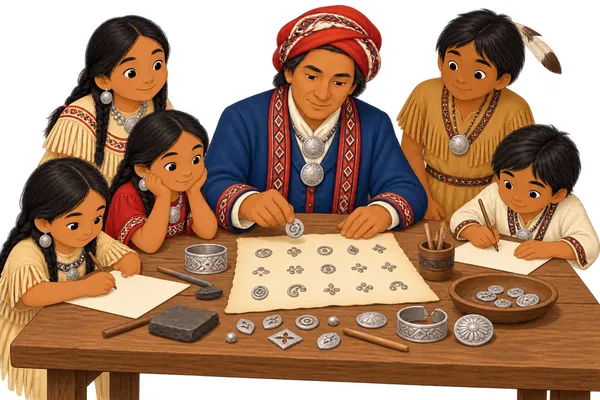
1Sequoyah was a Cherokee man who was born in the late 1700s in what is now the state of Tennessee. As a young man, he worked as a silversmith. He made jewelry and other objects out of silver. Sequoyah spoke the Cherokee language, but at that time, there was no way to write it down.
2Sequoyah noticed that some settlers could share ideas by making marks on paper. Someone far away could look at the marks and understand the message. Sequoyah wanted the Cherokee people to be able to do this, too. He decided to create a way to write their language.
3At first, Sequoyah tried to make a different picture for every word. He soon saw that this plan would not work. There were far too many words, and no one could remember thousands of pictures. So he changed his plan. He listened carefully to the sounds that make up Cherokee words. Then he made one symbol for each syllable, or small sound part, in the language.
4The work took Sequoyah many years. In the early 1820s, he shared his finished system with Cherokee leaders. Because each symbol stood for a sound that people already knew, the system was easy to learn. Many people learned to read it quickly. Within a few years, thousands of Cherokee people could read and write in their own language.
5The Cherokee people began to use the new writing in many ways. They wrote letters to family members who lived far away. They printed books, and they started a newspaper with pages in both Cherokee and English. Today, people still use Sequoyah's writing system to read, write, and teach the Cherokee language.
The preview shows the first questions. Unlock the worksheet to see all of it.
Related worksheets
 Worksheet
Grade 3
How a Compass Finds North
Reading: Informational Text · RI.3.1
Premium9 questions
 Worksheet
Grade 3
Frederick Law Olmsted: Parks for Everyone
Reading: Informational Text · RI.3.1
Premium9 questions
 Worksheet
Grade 3
Fire Lookouts: Watching Over the Forest
Reading: Informational Text · RI.3.1
Premium10 questions
 Worksheet
Grade 3
Mushrooms: Not Plants at All
Reading: Informational Text · RI.3.1
Free9 questions
 Worksheet
Grade 3
How to Build a Jar Terrarium
Reading: Informational Text · RI.3.1
Premium10 questions
 Worksheet
Grade 3
Sea Otters: Ask and Answer
Reading: Informational Text · RI.3.1
Premium9 questions