Grade 3 · Social StudiesGEO.3.4Premium
Nightfall at Dunlark’s Running Track
Compare lighting plans for a town running track and explain how people adapt to darkness, change their surroundings, and weigh the effects.
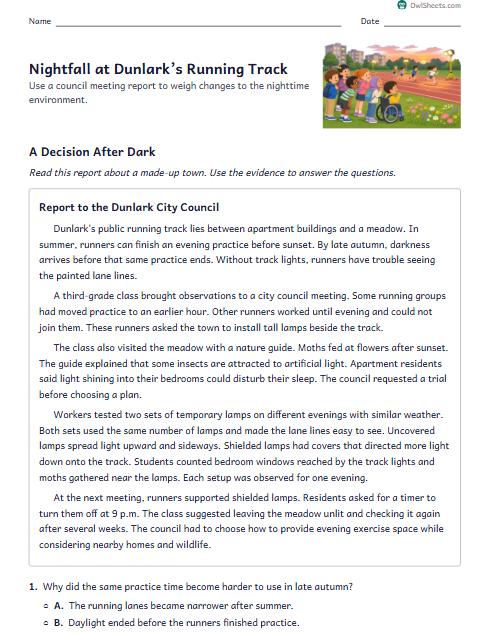
Preview
OwlSheets.com
Nightfall at Dunlark’s Running Track
Use a council meeting report to weigh changes to the nighttime environment.
A Decision After Dark
Read this report about a made-up town. Use the evidence to answer the questions.
Report to the Dunlark City Council
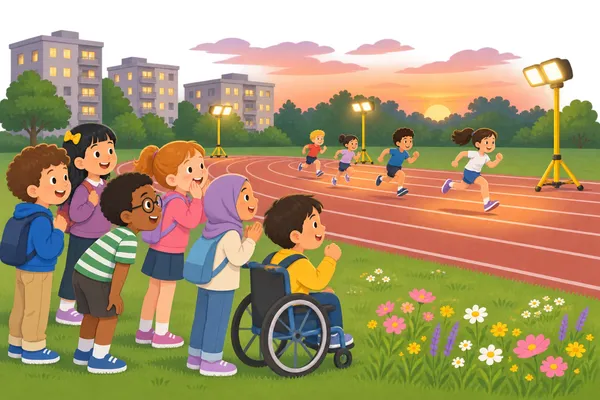
Dunlark’s public running track lies between apartment buildings and a meadow. In summer, runners can finish an evening practice before sunset. By late autumn, darkness arrives before that same practice ends. Without track lights, runners have trouble seeing the painted lane lines.
A third-grade class brought observations to a city council meeting. Some running groups had moved practice to an earlier hour. Other runners worked until evening and could not join them. These runners asked the town to install tall lamps beside the track.
The class also visited the meadow with a nature guide. Moths fed at flowers after sunset. The guide explained that some insects are attracted to artificial light. Apartment residents said light shining into their bedrooms could disturb their sleep. The council requested a trial before choosing a plan.
Workers tested two sets of temporary lamps on different evenings with similar weather. Both sets used the same number of lamps and made the lane lines easy to see. Uncovered lamps spread light upward and sideways. Shielded lamps had covers that directed more light down onto the track. Students counted bedroom windows reached by the track lights and moths gathered near the lamps. Each setup was observed for one evening.
At the next meeting, runners supported shielded lamps. Residents asked for a timer to turn them off at 9 p.m. The class suggested leaving the meadow unlit and checking it again after several weeks. The council had to choose how to provide evening exercise space while considering nearby homes and wildlife.
- A. The running lanes became narrower after summer.
- B. Daylight ended before the runners finished practice.
- C. The meadow’s flowers covered the painted lane lines.
- D. The apartment buildings blocked the running lanes.
- A. They used the daylight that was already available.
- B. They made the autumn sunset happen later.
- C. They directed bedroom light onto the lanes.
- D. They changed the positions of the painted lines.
The preview shows the first questions. Unlock the worksheet to see all of it.
Related worksheets
Two Ways to Move Gypsum in Flintmere
Grade 3 · GEO.3.4
13 questionsPremium
A Hillside Letter from Brackenfold Orchard
Grade 3 · GEO.3.4
14 questionsFree
Heat and Dust at the Ochre Bend Market
Grade 3 · GEO.3.4
13 questionsPremium
Sound Solutions at Redwood Crest School
Grade 3 · GEO.3.4
15 questionsPremium
Winter Choices in Frostmere
Grade 3 · GEO.3.4
15 questionsPremium
Rainwise at Redbud School
Grade 3 · GEO.3.4
14 questionsPremium