Grade 3 · Social StudiesGEO.3.4
A Hillside Letter from Brackenfold Orchard
Read an orchard manager's letter and compare soil-loss data to explain adaptations, changes to the land, and their effects.
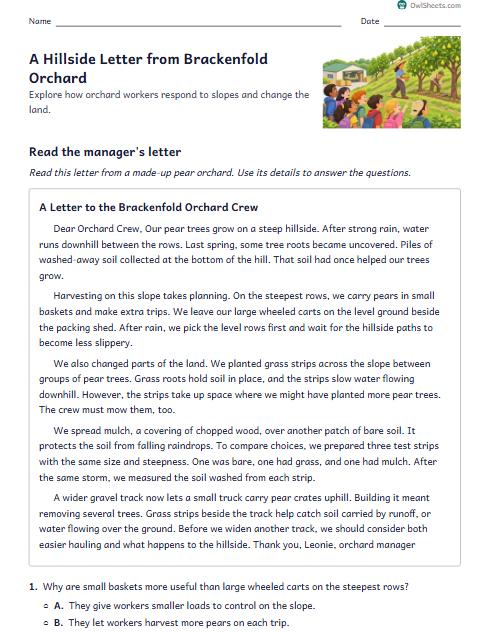
Preview
OwlSheets.com
A Hillside Letter from Brackenfold Orchard
Explore how orchard workers respond to slopes and change the land.
Read the manager's letter
Read this letter from a made-up pear orchard. Use its details to answer the questions.
A Letter to the Brackenfold Orchard Crew
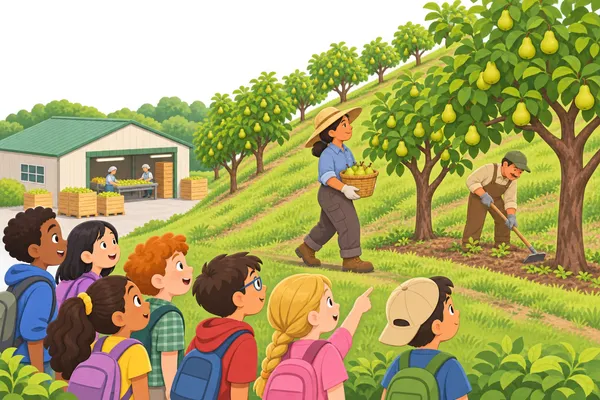
Dear Orchard Crew, Our pear trees grow on a steep hillside. After strong rain, water runs downhill between the rows. Last spring, some tree roots became uncovered. Piles of washed-away soil collected at the bottom of the hill. That soil had once helped our trees grow.
Harvesting on this slope takes planning. On the steepest rows, we carry pears in small baskets and make extra trips. We leave our large wheeled carts on the level ground beside the packing shed. After rain, we pick the level rows first and wait for the hillside paths to become less slippery.
We also changed parts of the land. We planted grass strips across the slope between groups of pear trees. Grass roots hold soil in place, and the strips slow water flowing downhill. However, the strips take up space where we might have planted more pear trees. The crew must mow them, too.
We spread mulch, a covering of chopped wood, over another patch of bare soil. It protects the soil from falling raindrops. To compare choices, we prepared three test strips with the same size and steepness. One was bare, one had grass, and one had mulch. After the same storm, we measured the soil washed from each strip.
A wider gravel track now lets a small truck carry pear crates uphill. Building it meant removing several trees. Grass strips beside the track help catch soil carried by runoff, or water flowing over the ground. Before we widen another track, we should consider both easier hauling and what happens to the hillside. Thank you, Leonie, orchard manager
- A. They give workers smaller loads to control on the slope.
- B. They let workers harvest more pears on each trip.
- C. They make the hillside paths level enough for trucks.
- D. They keep rainwater from washing soil downhill.
- A. Grass holds soil → less soil washes away → more soil stays near tree roots.
- B. Grass covers soil → the slope becomes level → carts replace baskets.
- C. Grass speeds up runoff → more soil washes away → tree roots gain soil.
- D. Grass takes up space → more pear trees fit → the harvest grows larger.
Some tree roots became uncovered.Workers left large carts on level ground.Grass strips needed mowing.Piles of washed-away soil collected below.
- A. They save harvesting trips but leave more pears on trees.
- B. They make hauling easier but require removing track gravel.
- C. They help keep soil but leave less room for pear trees.
- D. They make paths level but require smaller pear baskets.
- A. Planting grass changes the weather; using carts changes the hillside's shape.
- B. Waiting to pick changes the slope; planting grass changes the work schedule.
- C. Carrying small baskets changes the land; adding gravel changes the weather.
- D. Waiting to pick changes workers' actions; adding gravel changes the land.
Study the test strips
Use the graph and the letter. These are made-up measurements from the orchard's three test strips after one storm.
The grass strip lost fewer cups of soil than the bare strip.
- A. Both coverings reduced soil loss compared with bare ground.
- B. Both coverings caused about the same soil loss as bare ground.
- C. Mulch kept more soil in place than grass did.
- D. Bare ground kept more soil in place than covered ground.
- A. Measure the width of baskets used at harvest.
- B. Repeat the comparison after several more storms.
- C. Compare how neatly the three strips were labeled.
- D. Count the pear crates beside the packing shed.
- A. The first wider track gave small trucks room to carry pears.
- B. A wider track would let workers leave more crates uphill.
- C. A wider track would change where the truck could travel.
- D. The first wider track required the orchard to remove trees.
Use the ideas
Apply what you learned to new situations. Use evidence when you write your answers.
- A. Cover a path with gravel from top to bottom.
- B. Carry lighter boxes and make additional trips.
- C. Build steps into the steepest part of the slope.
- D. Dig a wider road down the side of the hill.
- A. More soil stays uphill because tree roots become uncovered.
- B. Less soil washes downhill because bare ground slows runoff.
- C. More soil washes downhill because fewer roots hold it in place.
- D. Less soil moves downhill because water flows faster.
How much would the fence reduce wind near the trees?Would the fence shade trees that need sunlight?How many small baskets does Brackenfold use on its slope?Which Brackenfold hillside rows are picked after rain?
Related worksheets
Two Ways to Move Gypsum in Flintmere
Grade 3 · GEO.3.4
13 questionsPremium
Nightfall at Dunlark’s Running Track
Grade 3 · GEO.3.4
15 questionsPremium
Heat and Dust at the Ochre Bend Market
Grade 3 · GEO.3.4
13 questionsPremium
Sound Solutions at Redwood Crest School
Grade 3 · GEO.3.4
15 questionsPremium
Winter Choices in Frostmere
Grade 3 · GEO.3.4
15 questionsPremium
Rainwise at Redbud School
Grade 3 · GEO.3.4
14 questionsPremium