OwlSheets
← Exit

Family Traits at the Discovery Pavilion

0 / 13

Family Traits at the Discovery Pavilion

Use family records to compare traits in plants and animals.

Investigate Plant Families

Read the class investigation. Use the plant graph and parent records to answer the questions.

A Class Checks Family Records

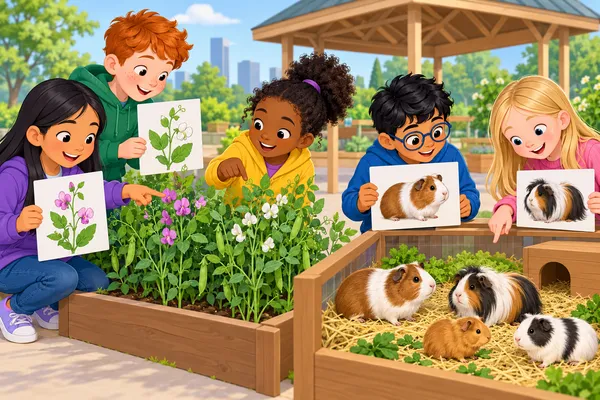
A class visited a city park's discovery pavilion to investigate family traits. A trait is a feature of a living thing, such as flower color or coat pattern. Offspring are the young of parents. Park staff shared photographs and records of pea plants and guinea pigs.

Step 1: Students checked the family labels in the staff records. They used these labels to identify each offspring's parents rather than guessing from how it looked.

Step 2: Students compared fully open pea flowers. In Family P, one parent had purple flowers and the other had white flowers. Both parents in Family Q had white flowers. The class recorded one flower color for each offspring plant.

Step 3: Students examined guinea pig photographs. Family R had one black parent with white patches and one solid-black parent. Family S had one brown parent with white patches and one solid-brown parent. Students recorded each offspring's coat.

Step 4: Students counted offspring with each trait and made graphs. They compared families, not different care treatments. Within each kind of living thing, staff kept care the same. Students did not change food, water, or growing conditions.

Pea Offspring: Flower Colors012345678P: purpleP: whiteQ: purpleQ: whiteFamily and flower colorOffspring plants
1.
Which comparison of the offspring is supported by the graph?
Question 1 options
2.

How many more Family P offspring have purple flowers than white flowers? offspring plants

3.
Select the two observations that connect an offspring's flower color to a parent's flower color.

4.
A student says, "White flowers cannot be a family trait in P because most P offspring have purple flowers." Which response best uses the records?
Question 4 options
5.
Which next step would give the class more evidence about flower traits shared by parents and offspring?
Question 5 options

Investigate Animal Families

Use the guinea pig graph and the parent records in the investigation. A patched coat has white patches; a solid coat has no white patches.

Guinea Pig Offspring: Coats01234R: black-whiteR: solid blackS: brown-whiteS: solid brownFamily and coatOffspring
6.
Which observation gives evidence of a coat trait shared by a parent and its offspring?
Question 6 options
7.

Combine both families. How many offspring have white patches on their coats? offspring

8.
Sort the statements by whether the guinea pig graph supports them.
9.
Do coat traits vary among the offspring in Family S? State a claim and use numbers from the graph as evidence.

Think Across the Records

Use both investigations to judge claims and apply what the class found.

10.
A visitor says, "These records show that every pea plant has white flowers." Which evidence challenges that claim?
Question 10 options
11.
A new guinea pig has black fur with white patches. A student guesses that it belongs to Family R. What should the class do before adding it to R's graph?
Question 11 options
12.
Which new record would show BOTH flower-color resemblance to parents AND flower-color differences among offspring?
Question 12 options
13.
A visitor says, "If traits come from parents, offspring in one family must all look the same." Use Family P and Family R to explain why the records do not support this claim. Include parent traits and offspring numbers.