
WorksheetPremium
Choosing Wildlife Panels for the Curling Lodge
Compare winter wildlife exhibit designs using musk ox observations and honeybee temperature data to argue how groups can help animals survive.
Grade 3ScienceInteractive · Printable
Aligned to3-LS2-1
Or unlock every Premium worksheet with Premium
What’s included
- Single worksheet
- Auto-graded online
- 1 NGSS standard
- Printable answer key
- 13 questions
- Classroom-ready
Details
- Format
- Interactive · Printable
- Grade
- Grade 3
- Subject
- Science
- Question types
- Fill in the blank, Multiple choice, Circle the answer, Sorting, Short answer
About this worksheet
What students practice
- Students connect musk ox group behavior to protecting young from danger.
- Students compare honeybee cluster temperatures as evidence about warmth.
- Students judge exhibit designs and argue how animal groups can help members survive.
How to use
Read the wildlife notes together, then have students compare the graph and proposed exhibit designs. Finish by sharing evidence-based arguments.
Curriculum
NGSS standard covered
Argue that some animals live in groups that help the members survive.
Preview
OwlSheets.com
Choosing Wildlife Panels for the Curling Lodge
Judge exhibit designs using evidence about animal groups.
Plan the Wildlife Display
Read the notes. Use the observations to judge the proposed display panels.
A Display for a Snowy Town
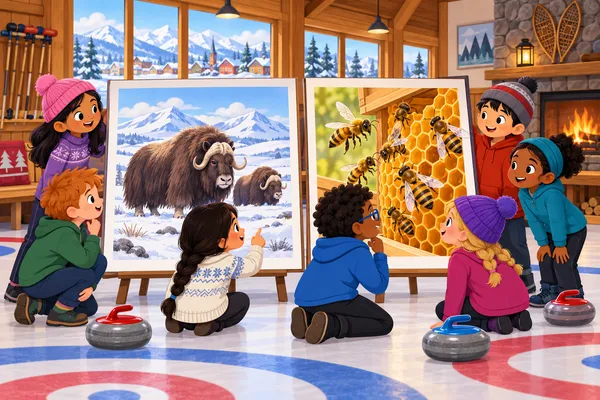
Snow covers the streets around the town's curling lodge. Inside, volunteers are planning a wildlife display for winter visitors. Each panel will have a drawing and a short explanation. The volunteers want visitors to understand how living in a group can help some animals survive. They study wildlife notes before choosing their designs.
One set of notes describes a video of musk oxen, large animals that live in cold northern places. Several calves feed near the adults. When wolves approach, the adults move close together around the calves. The adults face outward, with their horns toward the wolves. The calves stand in the middle. Wolves remain outside the group and later leave. The calves are still inside the group when the video ends.
Another set of notes describes honeybees during cold weather. Workers crowd together in a cluster inside their hive. Bees at the edge form a tightly packed outer layer. Bees near the center have other bees around them. Honeybees need enough warmth to stay alive through winter. An observer can use temperature sensors to compare places inside a cluster without pulling it apart. The volunteers will use practice temperature data to plan their honeybee panel.
- A. Calves surround the adults and face toward the wolves.
- B. Adults spread apart while calves stand beside the wolves.
- C. Adults surround the calves and face toward the wolves.
- D. Adults and calves form a line facing away from the wolves.
- A. A wolf might have an easier path toward the calf.
- B. The calf might have more adults between it and a wolf.
- C. The calf might grow horns before the wolves arrive.
- D. The wolves might be blocked by a tighter adult ring.
The preview shows the first questions. Unlock the worksheet to see all of it.
Related worksheets
 Worksheet
Grade 3
A Schooling Squid Display
Life Science · 3-LS2-1
Premium15 questions
 Worksheet
Grade 3
Flock Clues at the Harvest Orchard
Life Science · 3-LS2-1
Premium14 questions
 Worksheet
Grade 3
Signals in the Reef Aquarium
Life Science · 3-LS2-1
Premium14 questions
 Worksheet
Grade 3
Animal Teamwork at the Kitchen Foldout Desk
Life Science · 3-LS2-1
Premium14 questions
 Worksheet
Grade 3
Mussel Connections on a Cobble Beach
Life Science · 3-LS2-1
Premium14 questions
 Worksheet
Grade 3
Flocks at the Reservoir Sandbar
Life Science · 3-LS2-1
Free13 questions