OwlSheets
← Exit

Force Questions at the Corner Bike Shop

0 / 14

Force Questions at the Corner Bike Shop

Use test results to ask questions about pushes and pulls without touching.

A Magnet Near a Paper Clip

Read the investigation. Use the graph to answer questions about the magnet tests.

Science on a Busy Block

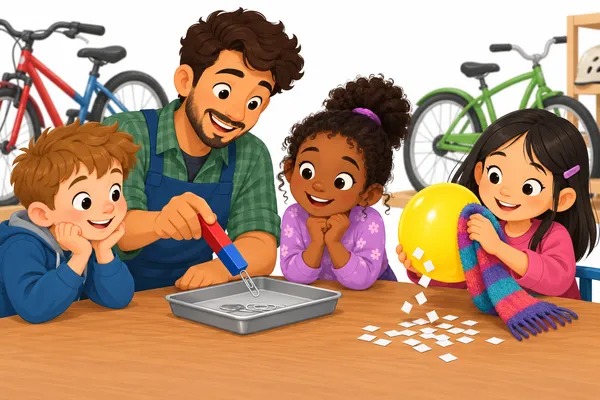
Buses pass, bells ring, and neighbors stop at the corner bike shop. During a neighborhood science afternoon, the shop hosts two small investigations inside, away from street breezes. An adult handles the magnets and keeps them away from mouths and electronic devices.

For the first investigation, the group places a steel paper clip on a smooth tray. They hold a bar magnet still near the clip, leaving a gap. They change only the starting gap. They keep the magnet, clip, tray, and facing end of the magnet the same. At each gap, they make five tries. Each try lasts five seconds. They count a success only if the clip begins moving toward the magnet before the two touch.

For the second investigation, the group uses balloons and tiny paper squares. Rubbing a balloon with a dry wool scarf can give it electric charge. The group changes the number of rubs. They record whether the paper starts moving toward the balloon while a gap remains. Both investigations record motion, not just whether objects eventually touch.

Paper Clip Moved Before Contact0123451 cm2 cm3 cm4 cmStarting gapSuccessful tries out of 5
1.

How many more tries were successful at 1 cm than at 3 cm? more tries

2.
The group will repeat one starting gap. Based on the graph, which gap is most likely to make the clip move before contact?
Question 2 options
3.
Why does the group check whether the clip starts moving while a gap remains?
Question 3 options
4.
The group asks, “Would a stronger magnet move this clip from 4 cm away?” Which plan best tests that question?
Question 4 options
5.
Sort the questions. Which can be answered using the graph, and which need a new test?

A Balloon Near Paper

Use the test notes and results. Think about what the group changed and what it could test next.

The group holds each balloon still, 1 cm from a paper square, for five seconds. For each try, they use a fresh, dry balloon of the same kind and a fresh paper square of the same size. They use the same scarf. They make five tries for each rubbing amount.
Balloon Test Results
Rub count | Tries when paper moved toward the balloon before contact
0 rubs | 0 out of 5
10 rubs | 3 out of 5
20 rubs | 5 out of 5
6.
Which question do these balloon tests help answer?
Question 6 options
7.
Which pattern is supported by these results?
Question 7 options
8.

After 10 rubs, in how many of the five tries did the paper move before contact? tries

9.
Next, the group asks, “Does the starting gap affect whether paper moves toward a rubbed balloon?” Which plan tests only that change?
Question 9 options
10.
The group has a wool scarf and a cotton cloth. Write a question about how the rubbing material might affect the balloon's pull on paper without touching it. Name two things to keep the same.

Plan the Next Investigation

Use the new observations and the earlier results to choose useful questions and support an explanation.

The adult also tests two bar magnets. Their ends are called poles and are labeled north and south. One magnet can slide on a smooth tray. The adult holds the other magnet nearby without touching it. The starting gap is the same in both tests.
North facing north: the sliding magnet moves away.
North facing south: the sliding magnet moves closer.
11.
Which cause-and-effect question best matches the change made in these two magnet tests?
Question 11 options
12.
Match each investigation question to the one thing the group should change.
13.
A visitor says, “A magnet must touch a paper clip before it can pull the clip.” Do the graph results support that claim? Explain using a number and a starting gap from the graph.
14.
A visitor asks, “Could moving air, rather than the rubbed balloon, be making the paper move?” Which test would best help check this?
Question 14 options