
WorksheetPremium
Tiny Bands, Big Clues: How Scientists Study Birds
Read an original science article about bird banding, then answer questions about the steps, key details, signal words and text evidence.
Grade 3ELAInteractive · Printable
Aligned toRI.3.10
Or unlock every Premium worksheet with Premium
What’s included
- Single worksheet
- Auto-graded online
- 1 Common Core standard
- Printable answer key
- 9 questions
- Classroom-ready
Details
- Format
- Interactive · Printable
- Grade
- Grade 3
- Subject
- ELA
- Question types
- Fill in the blank, Multiple choice, Matching, Circle the answer, Sorting, Short answer
About this worksheet
What students practice
- Students read a grade 3 science article on their own and answer questions about its key details.
- Students follow the steps of a science process using signal words and text evidence.
How to use
Have students read the article on their own, then answer the questions. Talk about the last question together to check that they understand why each band matters.
Curriculum
Common Core standard covered
By the end of the year, read and understand informational texts in history, science, and technical subjects at the high end of grades 2-3, independently.
Preview
OwlSheets.com
Tiny Bands, Big Clues: How Scientists Study Birds
Read a science article and answer the questions.
Read the article
Read the science article carefully. Then answer the questions.
Tiny Bands, Big Clues
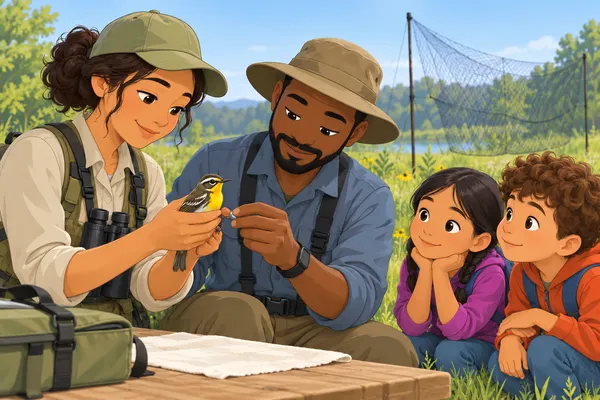
1Where does a little songbird go in winter? How long can it live? To find out, some scientists put tiny bands on the legs of wild birds. This work is called bird banding, and the people who do it are called banders.
2A bird band is a thin ring made of light metal. Each band has its own number, like a name tag. The band is so light that the bird can fly, eat, and sing just as it did before. Only people with special training and permission may band wild birds.
3First, banders catch the birds gently. They often use a mist net. A mist net is made of thread so thin that birds can hardly see it. When a bird flies into the net, it drops into a soft pocket. Banders check their nets often so that no bird has to wait long.
4Next, a bander slips a band around one of the bird's legs and gently closes it. Then the bander measures the bird's wing, weighs the bird, and writes everything down. Finally, the bander lets the bird fly away. The whole visit takes just a few minutes.
5The real clues come later. Sometimes a banded bird is caught again at another place far away. The banders there read the number on its band and look it up. They learn where the bird was first banded and how many years ago that was.
6People have banded birds for more than one hundred years. Their records helped show that many birds fly very long distances each spring and fall. One band holds just one number, but many bands together tell a big story about the lives of birds.
The preview shows the first questions. Unlock the worksheet to see all of it.
Related worksheets
 Worksheet
Grade 3
Sundials: Telling Time with Shadows
Reading: Informational Text · RI.3.10
Premium11 questions
 Worksheet
Grade 3
Puff! How a Pufferfish Stays Safe
Reading: Informational Text · RI.3.10
Premium10 questions
 Worksheet
Grade 3
The Baobab: A Tree Built for Dry Land
Reading: Informational Text · RI.3.10
Premium10 questions
 Worksheet
Grade 3
Termite Towers: Tiny Insects, Giant Homes
Reading: Informational Text · RI.3.10
Premium9 questions
 Worksheet
Grade 3
The General Store: Shopping Long Ago
Reading: Informational Text · RI.3.10
Free9 questions
 Worksheet
Grade 3
Moving Stairs: How an Escalator Works
Reading: Informational Text · RI.3.10
Premium9 questions