OwlSheets
← Exit

Earth Water Search at the Jump-Rope Circle

0 / 13

Earth Water Search at the Jump-Rope Circle

Use observations to find water and describe its form.

Water in Different Places

Read the class investigation. Use the reports to answer the questions.

The Jump-Rope Circle Investigation

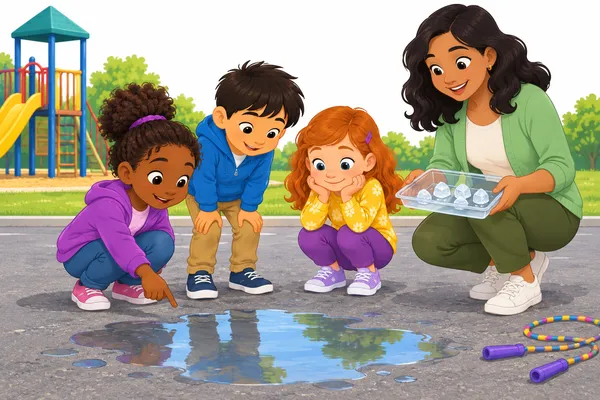
At the playground's jump-rope circle, Nia's class noticed a puddle. They wondered where else water could be found on Earth. They made a plan.

Step 1: Look at the puddle without stepping in it. Step 2: Read picture reports from other places. Step 3: Ask the same two questions about each place: Where is the water? What form is it in? Step 4: Compare the evidence. Ice and snow are solid water. Water that pours or drips is liquid.

These were the class's reports:

Ocean: Waves splash against a rocky shore.

River: Water flows between two banks and around rocks.

Lake: A hard layer of ice covers the top. Water from beneath the ice pours from a researcher's sampler.

Glacier: A thick mass of hard ice rests on a mountain slope.

Below ground: Water fills spaces between grains of sand. It drips from a well's pump.

Hill: Snow covers the grassy top.

Playground: Puddle water runs into a shallow crack beside the jump-rope circle.

1.
Which pair of reports gives evidence of liquid water in two places away from the playground?
Question 1 options
2.
Which note best describes the lake in the report?
Question 2 options
3.
Use the observations to sort these examples of water.
4.
How are the ocean waves and the glacier alike and different?
Question 4 options

Watch the Water

Read what the class did next. Use the starting and ending observations as evidence.

A Tray Beside the Circle

The lake report gave the class another question: What might happen to ice on a warmer day? Their teacher brought plain ice from a freezer to the playground. No one tasted the ice or the water.

Step 1: The teacher placed two small ice pieces in a clear tray beside the jump-rope circle. At the start, the pieces were hard. No liquid was visible.

Step 2: The class left the tray in the warm air for 20 minutes. They kept the same tray and spot and added nothing.

Step 3: They counted the hard pieces again and looked for liquid. They found zero hard pieces. A pool of water moved when the teacher gently tipped the tray.

5.
Which description fits the change in the tray?
Question 5 options
6.
Nia says, "The water was still in the tray at the end, but it was liquid." Underline the TWO ending observations that support her claim.

7.
Suppose some lake ice changes the same way the tray ice did. What form will that changed water have? Use an ending observation from the tray as evidence.
8.
The tray helped the class study a change in water's form. Why did they also need the place reports?
Question 8 options

Check Ideas About Earth's Water

Use the investigation and reports to check ideas and consider new evidence.

9.
A visitor sees dry sand and says, "There is probably no water beneath this spot." Which report gives a reason to check below the surface?
Question 9 options
10.
A new report describes a cave. Hard icicles hang from its roof, and water drips into a pool. How should the class label the water in this report?
Question 10 options
11.
The class wants evidence of water in another place on Earth. Which new source would help most?
Question 11 options
12.
Circle the TWO questions the original place reports give enough evidence to answer.

13.
Complete the class's claim: "Earth has water in different places and in different forms." Name one place from the original reports with solid water and a different place with liquid water. Include an observation for each.