← Exit

Pay and Purchases at Parcel Court

0 / 13

Pay and Purchases at Parcel Court

Use a map and a worker’s note to follow money.

Three Stops

Listen as your teacher reads the map and note. Circle each answer unless told to do something else.

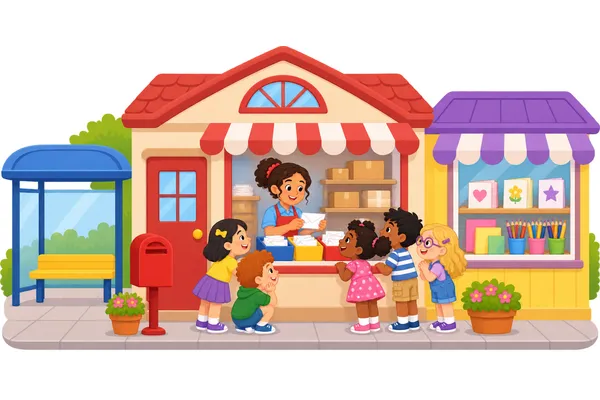
A pretend map of Parcel Court
Three places stand in a row.
LEFT: Bus Stop. Pay a fare to ride the bus.
MIDDLE: Post Office. Pay to have a letter delivered.
RIGHT: Paper Store. Buy cards, envelopes, and pencils.

Esme’s Friday Note

My name is Esme. I work at the post office. I sort letters so they can go to the right places. The post office pays me each Friday for my work that week.

Today I used some of my pay to buy a card at the paper store. Then I paid a fare and rode the bus home.

A good is an object we buy, such as a card. A service is work we pay someone to do, such as driving us on a bus.

1.
Esme needs an envelope. Then she wants her letter delivered. Which stops should she visit in order?
Question 1 options
2.
Why is Esme’s bus ride a service?
Question 2 options
3.
Circle ONE detail that shows Esme gets money for doing a job.

4.
The paper store hires a clerk to fill its shelves. Which action is the work the store pays the clerk to do?
Question 4 options

Think About Pay

Use the map and note. Think about what people do to earn money.

5.
No shoppers visit the post office window one morning. Esme still sorts letters. Why does the post office still pay her?
Question 5 options
6.
Esme wants to spend some pay on a pencil. She starts at the post office and goes left. What should she change?
Question 6 options
7.
Esme sorts letters on Monday but gets her pay on Friday. What does this show?
Question 7 options
8.
Circle the TWO people who earn money in these new cases.

9.
A child writes, “The bus company pays its driver for buying a bus ticket.” Circle ONE change that makes the sentence correct.

Use the Map Again

Think about new purchases at the three stops. Use details to explain your written answers.

10.
The paper store owner uses money from card sales to pay for letter delivery. Esme uses some pay to buy cards. What does this show?
Question 10 options
11.
The paper store is closed. Esme still has some pay. Can she buy a service at each of the other two stops? Name both stops and tell what she could pay for.
12.
Jo buys an envelope. Then Jo pays to have a letter delivered. Jo says, “I bought two goods.” Which answer fixes the mistake?
Question 12 options
13.
A visitor says, “Esme earns money when she buys her card.” Is the visitor right? Use the note to tell when Esme earns money and what happens when she buys the card.