Grade 1 · Social StudiesHIS.1.2
Class Visits at Glasswing Park
Compare school lessons, travel, water tools, and pictures during two imagined city park visits, using a map described in words.
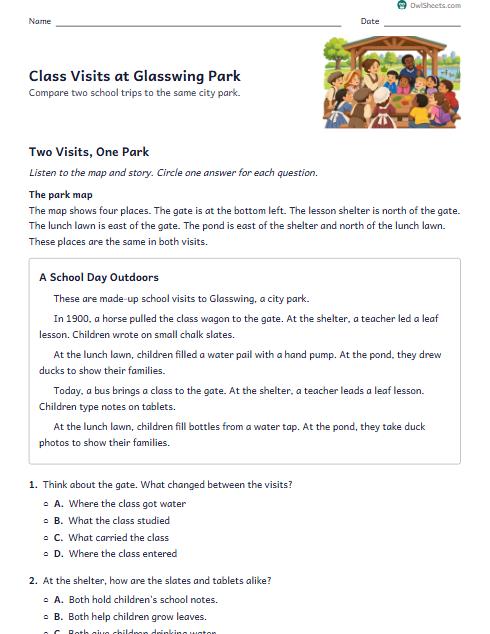
Preview
OwlSheets.com
Class Visits at Glasswing Park
Compare two school trips to the same city park.
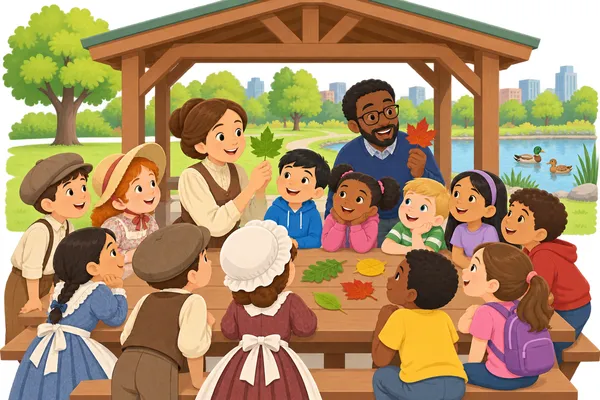
Two Visits, One Park
Listen to the map and story. Circle one answer for each question.
The map shows four places. The gate is at the bottom left. The lesson shelter is north of the gate. The lunch lawn is east of the gate. The pond is east of the shelter and north of the lunch lawn. These places are the same in both visits.
A School Day Outdoors
These are made-up school visits to Glasswing, a city park.
In 1900, a horse pulled the class wagon to the gate. At the shelter, a teacher led a leaf lesson. Children wrote on small chalk slates.
At the lunch lawn, children filled a water pail with a hand pump. At the pond, they drew ducks to show their families.
Today, a bus brings a class to the gate. At the shelter, a teacher leads a leaf lesson. Children type notes on tablets.
At the lunch lawn, children fill bottles from a water tap. At the pond, they take duck photos to show their families.
- A. Where the class got water
- B. What the class studied
- C. What carried the class
- D. Where the class entered
- A. Both hold children's school notes.
- B. Both help children grow leaves.
- C. Both give children drinking water.
- D. Both carry children to school.
- A. Children carry the same water holders.
- B. Children get water beside the gate.
- C. Children need water in both visits.
- D. Children use tablets to get water.
- A. How children travel to the park
- B. Why children make the pictures
- C. What children use for school notes
- D. How children make each picture
- A. Tablets and a water tap
- B. Chalk slates and a water tap
- C. Tablets and a hand pump
- D. Chalk slates and a hand pump
Use the Clues
Use the story to think about what changed and what stayed the same.
In 1900, a teacher led a leaf lesson.In 1900, a horse pulled the wagon.Today, children fill water bottles.Today, a teacher leads a leaf lesson.
- A. Take a photo with the slate
- B. Write notes about a leaf
- C. Type notes on the slate
- D. Charge the tablet with chalk
- A. Its travel matches today; its pictures match 1900.
- B. Its travel and pictures match today's story visit.
- C. Its travel and pictures match the 1900 visit.
- D. Its travel matches 1900; its pictures match today.
Related worksheets
A Baggage Worker's Class Letter
Grade 1 · HIS.1.2
13 questionsPremium
Power Clues at the Science Center
Grade 1 · HIS.1.2
13 questionsPremium
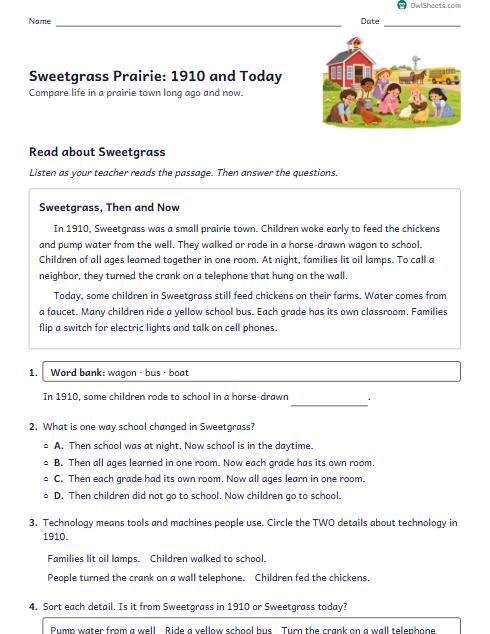
Sweetgrass Prairie: 1910 and Today
Grade 1 · HIS.1.2
12 questionsPremium
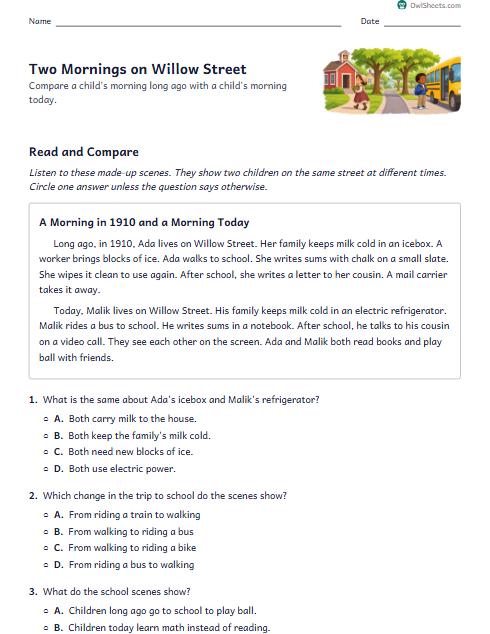
Two Mornings on Willow Street
Grade 1 · HIS.1.2
12 questionsPremium
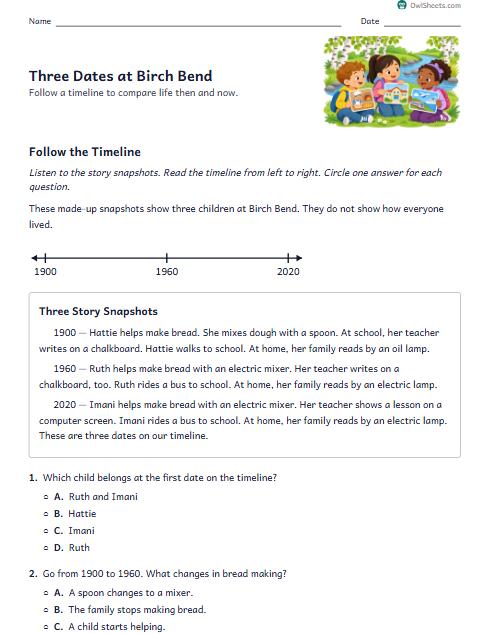
Three Dates at Birch Bend
Grade 1 · HIS.1.2
13 questionsPremium
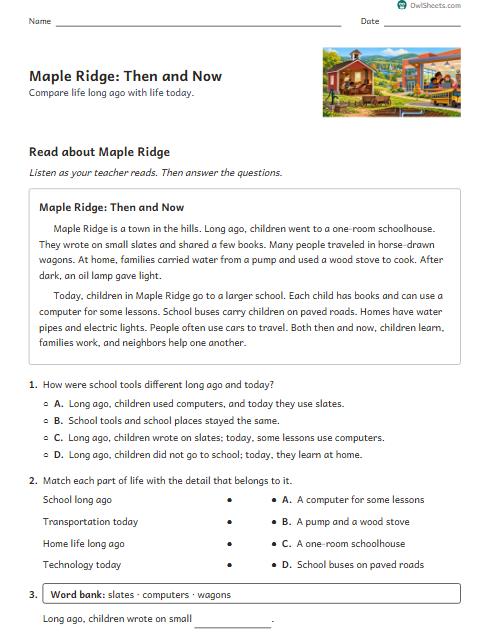
Maple Ridge: Then and Now
Grade 1 · HIS.1.2
14 questionsPremium