Grade 1 · Social StudiesCIV.1.3
Fair Turns at the Town Pool
Practice school and community rights, responsibilities, and fair voting through a small farm town's school swim lessons and public pool.
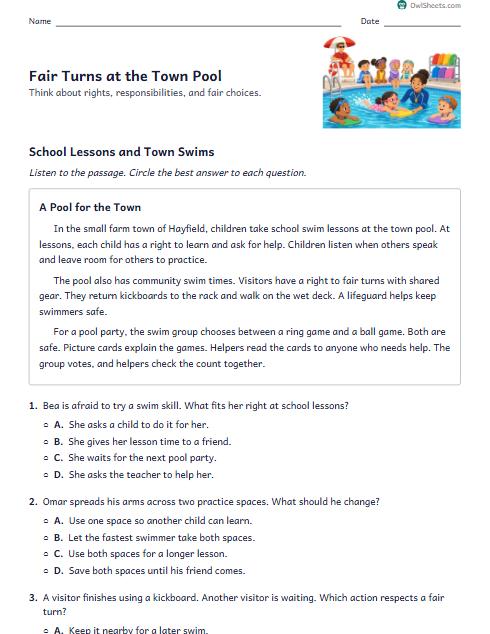
Preview
OwlSheets.com
Fair Turns at the Town Pool
Think about rights, responsibilities, and fair choices.
School Lessons and Town Swims
Listen to the passage. Circle the best answer to each question.
A Pool for the Town
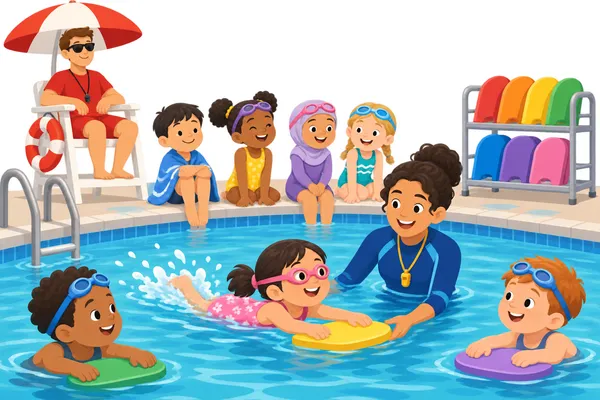
In the small farm town of Hayfield, children take school swim lessons at the town pool. At lessons, each child has a right to learn and ask for help. Children listen when others speak and leave room for others to practice.
The pool also has community swim times. Visitors have a right to fair turns with shared gear. They return kickboards to the rack and walk on the wet deck. A lifeguard helps keep swimmers safe.
For a pool party, the swim group chooses between a ring game and a ball game. Both are safe. Picture cards explain the games. Helpers read the cards to anyone who needs help. The group votes, and helpers check the count together.
- A. She asks a child to do it for her.
- B. She gives her lesson time to a friend.
- C. She waits for the next pool party.
- D. She asks the teacher to help her.
- A. Use one space so another child can learn.
- B. Let the fastest swimmer take both spaces.
- C. Use both spaces for a longer lesson.
- D. Save both spaces until his friend comes.
- A. Keep it nearby for a later swim.
- B. Return it so the next person can use it.
- C. Give it to a friend who just arrived.
- D. Leave it beside a towel for later.
- A. It lowers the chance of slipping into someone.
- B. It lets walkers move ahead in the line.
- C. It gives walkers first choice of games.
- D. It gives walkers extra time with the gear.
Listen when others speak.Choose between two party games.Leave room for others to practice.Check the vote count together.
Check the Group Choice
Use the passage and each new example. Think about what makes a choice fair.
- A. So Finn can count the votes first.
- B. So the helper can finish voting early.
- C. So Finn can understand the choices.
- D. So the helper can choose Finn's game.
- A. Ask the fastest swimmer to pick a game.
- B. Ask which game the helper likes best.
- C. Have two helpers recount both groups of votes.
- D. Keep the count because the helper already counted once.
- A. Let the loudest group say which game won.
- B. Agree on a fair tie plan before choosing again.
- C. Hide one vote for the less popular game.
- D. Give the helper's favorite game an extra vote.
Show the child both game cards.Let a friend choose for the child.Ask the child to watch this vote.Let the child vote with the group.
Use the Ideas
Think about rights and responsibilities at school and in the community.
- A. People make room for others to take part.
- B. People choose how long others may stay.
- C. People earn turns by being good swimmers.
- D. People keep their places for their friends.
- A. Let the older children decide the rule.
- B. Allow running if more children vote for it.
- C. Let children who vote for running try it.
- D. Keep the safety rule and offer safe choices.
Related worksheets
Two Rope Clubs in Sundune
Grade 1 · CIV.1.3
13 questionsPremium
The Reedbank Delta Care Walk
Grade 1 · CIV.1.3
13 questionsPremium
Moon Night on Mallow Key
Grade 1 · CIV.1.3
13 questionsPremium
Two Rooms Choose for Linden Park
Grade 1 · CIV.1.3
13 questionsPremium
The Coatroom Tag Decision
Grade 1 · CIV.1.3
13 questionsPremium
A Fair Choice by Willow River
Grade 1 · CIV.1.3
13 questionsPremium