
Worksheet
Family Clues at the Desert Study Hut
Compare desert foxes and prickly pear plants using class observation records to explain family likenesses and differences.
Grade 1ScienceInteractive · Printable
Aligned to1-LS3-1
What’s included
- Single worksheet
- Auto-graded online
- 1 NGSS standard
- Printable answer key
- 10 questions
- Classroom-ready
Details
- Format
- Interactive · Printable
- Grade
- Grade 1
- Subject
- Science
- Question types
- Fill in the blank, Multiple choice, Sorting, Short answer
About this worksheet
What students practice
- Students compare observed features of young desert foxes and their mother.
- Students compare young prickly pear plants with the plant that made their seeds.
- Students use observations to explain how young plants and animals resemble but differ from their parents.
How to use
Read the investigation and records aloud. Let students point to evidence as they answer, then discuss one likeness and one difference in each family.
Curriculum
NGSS standard covered
Explain that young plants and animals are like, but not exactly like, their parents.
Preview
OwlSheets.com
Family Clues at the Desert Study Hut
Compare young plants and animals with their parents.
Study a Fox Family
Listen to the investigation. Use the fox records to answer.
The Class Investigation
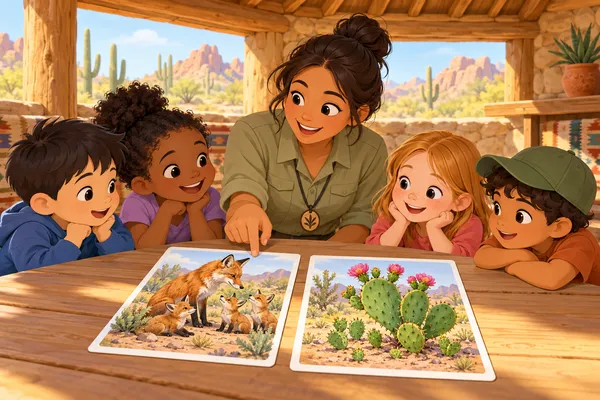
Noor's class visits a desert study hut. The class asks, “How are young living things like their parents? How are they different?” First, a guide gives the class labeled family photos. The labels tell which young belong to each parent. Next, the class looks at the fox family. The children compare the same features in each fox: fur shade, ear shape, tail tip, and body size. Then they write their observations. The children study photos, not live foxes.
- A. Tan fur and large bodies
- B. Round ears and black tail tips
- C. Pointed ears and black tail tips
- D. Pointed ears and white tail tips
Pup A is than its mother.
- A. Pup B has darker fur than Pup A.
- B. Pup A has a larger body than Pup B.
- C. Pup B has rounder ears than Pup A.
- D. Pup A has a lighter tail tip than Pup B.
Study a Plant Family
Listen to the next steps. Use the plant records to answer.
The Next Steps
Next, the guide brings out photos of a prickly pear plant family. These cacti have flat parts called pads. Two young plants grew from seeds made by the parent plant. The class checks the family labels. Then the children compare pad shape, pad color, spine length, and plant size. They write the results below. Last, the class puts the fox records beside the plant records. They look for a family pattern in both groups of living things.
- A. Long spines
- B. The same shade of green
- C. Large plant size
- D. Flat, oval pads
| The same in both | Different |
|---|---|
- A. It belongs because its spines are as long as the parent's.
- B. It belongs even though its shade of green is different.
- C. It does not belong because its pads have a different shape.
- D. It does not belong because young plants should be larger.
- A. Put the young plants' photos side by side and compare their green shades.
- B. Put the young plants' photos side by side and count their spines.
- C. Put the parent plant's photo beside a fox photo and compare their sizes.
- D. Put the parent plant's photo beside a fox photo and compare their shapes.
Put the Evidence Together
Think about both families. Use the class records.
- A. The young share the parent's size but have different shapes.
- B. The young have different ear and pad shapes from their parents.
- C. The young share some features with their parents and differ in others.
- D. The young match their parents in size, shape, and color.
Related worksheets
 Worksheet
Grade 1
Family Clue Cards on a Zoo Night Tour
Life Science · 1-LS3-1
Premium15 questions
 Worksheet
Grade 1
Noor's Desert Trail Family Journal
Life Science · 1-LS3-1
Premium14 questions
 Worksheet
Grade 1
Family Clues at the Early Spring Farm
Life Science · 1-LS3-1
Premium14 questions
 Worksheet
Grade 1
Family Features on Magnolia Walk
Life Science · 1-LS3-1
Premium13 questions
 Worksheet
Grade 1
Family Clues at the Elephant Overlook
Life Science · 1-LS3-1
Premium14 questions
 Worksheet
Grade 1
Family Records in the Living Collections Gallery
Life Science · 1-LS3-1
Premium13 questions