Grade 1 · Social StudiesECO.1.4
Maps and Lunches Near the Capitol
Use a capitol visit map and story to identify producers and consumers and reason about buying, barter, and agreed exchanges.
Preview
OwlSheets.com
Maps and Lunches Near the Capitol
Follow a visit map to learn how people get what they need.
A Capitol Visit
Listen to the map and story. Circle one answer for each question unless told otherwise.
Our Visit Map
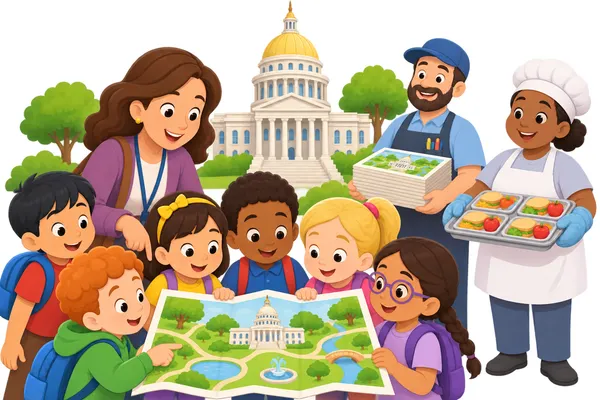
This made-up map has four places. The Capitol is north of the Bus Stop. The Print Shop is west of the Capitol. The Lunch Room is south of the Print Shop and west of the Bus Stop. Paths join these neighbors: Capitol–Print Shop, Print Shop–Lunch Room, Lunch Room–Bus Stop, and Bus Stop–Capitol.
Two Errands
Our class is visiting a state capitol. Rina works at the Print Shop. She prints maps for visitors. Oren works at the Lunch Room. He cooks lunches.
We start at the Bus Stop. We need lunch first, then maps, then a visit to the Capitol. At the Print Shop, our teacher pays Rina for maps. We use them during our visit.
Oren needs new menus for his tables. Rina needs lunch for herself and a helper. They agree to trade three printed menus for two lunches. Rina carries the menus to the Lunch Room. Oren gives her the lunches. No money changes hands.
- A. Print Shop → Capitol → Lunch Room
- B. Capitol → Print Shop → Lunch Room
- C. Lunch Room → Print Shop → Capitol
- D. Lunch Room → Capitol → Print Shop
Rina eats her lunch.Rina prints a visitor's map.Rina pays for a new pen.Rina uses a paper napkin.
- A. They use the maps on the visit.
- B. They print the maps for visitors.
- C. They cook the class's lunches.
- D. They sell the maps to the teacher.
- A. Rina paid Oren with the teacher's coins.
- B. Oren lent the lunches to Rina's helper.
- C. The teacher bought the lunches for Rina.
- D. Oren got printed menus for the lunches.
Check the Exchange
Use the map and the story. Think about what each person gives and gets.
- A. Maps to sell to the class
- B. Lunches for her and her helper
- C. Coins from the class's teacher
- D. Paper to print new menus
- A. A trade needs the same number of each good.
- B. The person giving more goods should get coins too.
- C. People can agree to trade different numbers.
- D. Goods need matching sizes to be traded.
Three printed menusThe teacher's coinsTwo lunchesThe class's maps
- A. Leave the pencil and take the map.
- B. Pay one coin and take the map.
- C. Borrow the map without asking.
- D. Pay two coins and get the map.
- A. It is a gift, not an exchange.
- B. It is a sale paid for with coins.
- C. It is barter paid for with food.
- D. It is a loan the visitor will give back.
Think It Through
Use what you know about making, using, and trading. Tell or write your answers to the last two questions.
- A. No. She is away from the Print Shop.
- B. Yes. She is making goods for others.
- C. No. Maps are used during a visit.
- D. Yes. Standing by a bus makes her one.
- A. A cook produces each good he buys.
- B. Buying paper is a way to barter.
- C. A producer can also be a consumer.
- D. Consumers use goods just at home.
Related worksheets
Trays for Gritstone School
Grade 1 · ECO.1.4
14 questionsPremium
Fans and Favors at the Family Reunion
Grade 1 · ECO.1.4
13 questionsPremium
Trading Along the River in Otter Bend
Grade 1 · ECO.1.4
13 questionsPremium
Two Ways to Get What You Need
Grade 1 · ECO.1.4
15 questionsPremium
Two Villages, Two Ways on Driftwood Island
Grade 1 · ECO.1.4
15 questionsPremium
The Sunpatch Farm Swap
Grade 1 · ECO.1.4
15 questionsPremium