Grade 5 · Social StudiesGEO.5.2Premium
The Prize Quilt of the Thirteen Colonies
A prize quilt at a county fair maps the thirteen colonies. Students locate colonies and explain how land, climate and water shaped life in each region.
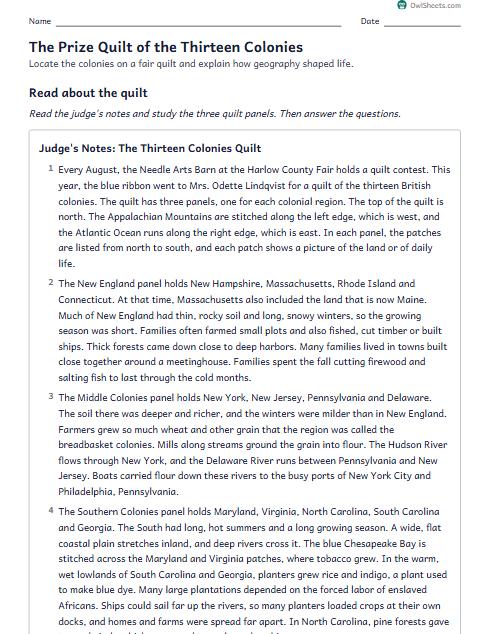
Preview
OwlSheets.com
The Prize Quilt of the Thirteen Colonies
Locate the colonies on a fair quilt and explain how geography shaped life.
Read about the quilt
Read the judge's notes and study the three quilt panels. Then answer the questions.
Judge's Notes: The Thirteen Colonies Quilt
1Every August, the Needle Arts Barn at the Harlow County Fair holds a quilt contest. This year, the blue ribbon went to Mrs. Odette Lindqvist for a quilt of the thirteen British colonies. The quilt has three panels, one for each colonial region. The top of the quilt is north. The Appalachian Mountains are stitched along the left edge, which is west, and the Atlantic Ocean runs along the right edge, which is east. In each panel, the patches are listed from north to south, and each patch shows a picture of the land or of daily life.
2The New England panel holds New Hampshire, Massachusetts, Rhode Island and Connecticut. At that time, Massachusetts also included the land that is now Maine. Much of New England had thin, rocky soil and long, snowy winters, so the growing season was short. Families often farmed small plots and also fished, cut timber or built ships. Thick forests came down close to deep harbors. Many families lived in towns built close together around a meetinghouse. Families spent the fall cutting firewood and salting fish to last through the cold months.
3The Middle Colonies panel holds New York, New Jersey, Pennsylvania and Delaware. The soil there was deeper and richer, and the winters were milder than in New England. Farmers grew so much wheat and other grain that the region was called the breadbasket colonies. Mills along streams ground the grain into flour. The Hudson River flows through New York, and the Delaware River runs between Pennsylvania and New Jersey. Boats carried flour down these rivers to the busy ports of New York City and Philadelphia, Pennsylvania.
4The Southern Colonies panel holds Maryland, Virginia, North Carolina, South Carolina and Georgia. The South had long, hot summers and a long growing season. A wide, flat coastal plain stretches inland, and deep rivers cross it. The blue Chesapeake Bay is stitched across the Maryland and Virginia patches, where tobacco grew. In the warm, wet lowlands of South Carolina and Georgia, planters grew rice and indigo, a plant used to make blue dye. Many large plantations depended on the forced labor of enslaved Africans. Ships could sail far up the rivers, so many planters loaded crops at their own docks, and homes and farms were spread far apart. In North Carolina, pine forests gave tar and pitch, which were used to seal wooden ships.
5Along the mountain border, Mrs. Lindqvist stitched the names of some Native nations, such as the Haudenosaunee in New York and the Cherokee in the southern mountains. These nations lived on lands that colonists claimed, and their people still live in these places today.
| Colony | Stitched picture |
|---|---|
| New Hampshire | Pine trees and a sawmill |
| Massachusetts | Fishing boat and codfish |
| Rhode Island | Harbor with sailing ships |
| Connecticut | Shipyard by a river |
| Colony | Stitched picture |
|---|---|
| New York | Hudson River and a port |
| New Jersey | Grain fields and a mill |
| Pennsylvania | Wheat fields and river docks |
| Delaware | Farm beside a wide river |
The preview shows the first questions. Unlock the worksheet to see all of it.
Related worksheets
Two Colonial Towns in the Library Map Room
Grade 5 · GEO.5.2
13 questionsPremium
Thirteen Colonies, Three Climates
Grade 5 · GEO.5.2
13 questionsFree
The Park's Thirteen-Colony Trail
Grade 5 · GEO.5.2
15 questionsPremium
Paddles and Sails: A Reading Circle on River Routes
Grade 5 · GEO.5.4
15 questionsPremium
Rillford's Weather Map Check
Grade 5 · GEO.5.1
14 questionsPremium
World Maps at the Fair's Kite Pavilion
Grade 5 · GEO.5.1
13 questionsFree