Grade 4 · Social StudiesECO.4.3
A Mending Shop in Sedgecross Delta
Use a delta shopkeeper’s letter and customer requests to examine starting a business, taking risks, and competing through service.
Preview
OwlSheets.com
A Mending Shop in Sedgecross Delta
Read an entrepreneur’s letter about promises, risks, and customers.
Read the shopkeeper’s letter
Read the fictional letter. Choose or circle answers supported by the details.
Zehra’s Letter to Her Cousin
Dear Basil, I have opened Thread Again, a clothing-mending shop in Sedgecross, a village in a river delta. Here the river divides into channels before reaching the sea. Passenger boats bring people from nearby settlements to our village. During high water, boat schedules sometimes change. A customer who misses a boat may not return for several days.
I knew how to sew, but opening a shop took more than sewing. I rented a small room along the raised main road, had my used sewing machine checked, and bought thread and needles. I tested the machine on different fabrics before deciding which repairs to offer. I also made an order book to record each repair, its price, and its promised collection day.
I paid for the room and supplies from my savings. Customers pay when they collect finished clothing. Yesterday I completed a jacket repair, but its owner missed the last boat. The repaired jacket is still here, and I have not received payment. My rent is due on Friday whether customers collect their clothes or not.
Another shop, Strong Stitch, already repairs clothing here. Its owner has a powerful machine for thick fabric. Mine handles lighter fabric well. Rather than buy another machine immediately, I send heavy-coat repairs there. That owner sends delicate shirt repairs to me. We still seek some of the same customers, but our equipment lets us offer different strengths.
To attract customers, I offer a fitting before I shorten trousers. I also write the collection date on a claim slip. One customer said a careful fit mattered more to her than the lowest price. Another chose Strong Stitch because her heavy coat needed its stronger machine. A third asked for a repair before his next boat trip.
I want a reputation for keeping promises, so I check my work calendar before accepting a deadline. Next Tuesday I have six hours available for sewing. The request list below shows three jobs people have asked about; I have not accepted them yet. I hope the shop succeeds, but this first letter is not a record of months of earnings! Your cousin, Zehra
- A. She becomes an entrepreneur after earning back her savings.
- B. Her customers organize the business by bringing her clothing.
- C. She organizes and risks money on a business offering an existing service.
- D. Her sewing skill makes her an employee of Strong Stitch.
- A. It helped her match the services offered to her equipment.
- B. It helped her calculate how many passengers used the boats.
- C. It helped her collect payment before customers placed orders.
- D. It helped her discover what Strong Stitch charged customers.
Zehra tested her machine on different fabrics.Zehra bought thread and needles with her savings.Zehra records promised collection days in an order book.A finished jacket remains unpaid for after its owner missed a boat.
- A. They pay the shop’s rent, but their schedules limit fabric choices.
- B. They bring potential customers, but changed schedules can delay collections.
- C. They supply sewing equipment, but their fares reduce clothing prices.
- D. They advertise fitting services, but their owners set repair deadlines.
- A. The shops can compete while helping customers find suitable repairs.
- B. The shops have agreed to charge the same repair prices.
- C. The shops have combined their earnings into one business.
- D. The shops have stopped seeking clothing-repair customers.
- A. The letter is not enough because Zehra mentions another shop.
- B. The letter is not enough because it lacks records across those months.
- C. The letter is enough because Zehra used savings to open the shop.
- D. The letter is enough because it describes several interested customers.
A customer valued a careful fit more than the lowest price.A customer chose the stronger machine for a heavy coat.A customer needed a repair before his next boat trip.A customer missed the boat and had not collected a jacket.
Check the promises
Use the request list and letter. Then apply the ideas to new business situations.
| Customer | Requested repair | Sewing hours needed | Requested completion |
|---|---|---|---|
| Halim | Shorten six trousers | 4 | Tuesday evening |
| Nessa | Repair four shirts | 3 | Tuesday evening |
| Vikram | Mend two skirts | 2 | Thursday evening |
- A. The Tuesday requests leave one sewing hour unused.
- B. The Thursday request needs more time than both Tuesday requests.
- C. The Tuesday requests need one more sewing hour than she has.
- D. The Thursday request must be completed before the Tuesday requests.
- A. As accepted for Thursday, because that date suits Zehra.
- B. As pending, because the customer has not agreed to the change.
- C. As canceled, because asking for a change ends an order.
- D. As completed, because Zehra has planned the sewing time.
- A. Pavel follows the work schedule when completing orders.
- B. Pavel receives money for the sewing work he performs.
- C. Selvi and Pavel both use sewing skills to finish aprons.
- D. Selvi chooses the products and risks her money on materials.
- A. “We explain your repair price before you place an order.”
- B. “Customers prefer our repairs to repairs at nearby shops.”
- C. “Our repairs cost less than repairs at nearby shops.”
- D. “Our repairs take less time than repairs at nearby shops.”
- A. She will own the machine after the first rental payment.
- B. She has transferred her customer orders to the machine’s owner.
- C. She must offer lower prices because the machine is rented.
- D. She owes the rental payment even if repair sales are too low.
Related worksheets
A Class Visit at Hazelwheel Dairy
Grade 4 · ECO.4.3
14 questionsPremium
A Yard-Letter Business in Avenstone
Grade 4 · ECO.4.3
13 questionsPremium
Two Ice-Pop Stands at Oak Plaza
Grade 4 · ECO.4.3
14 questionsPremium
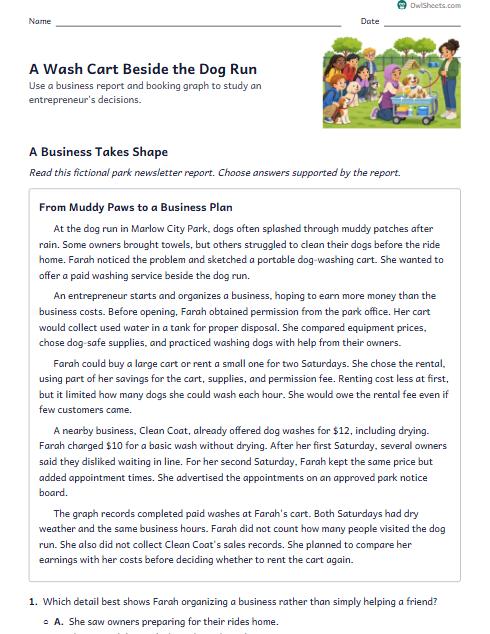
A Wash Cart Beside the Dog Run
Grade 4 · ECO.4.3
13 questionsPremium
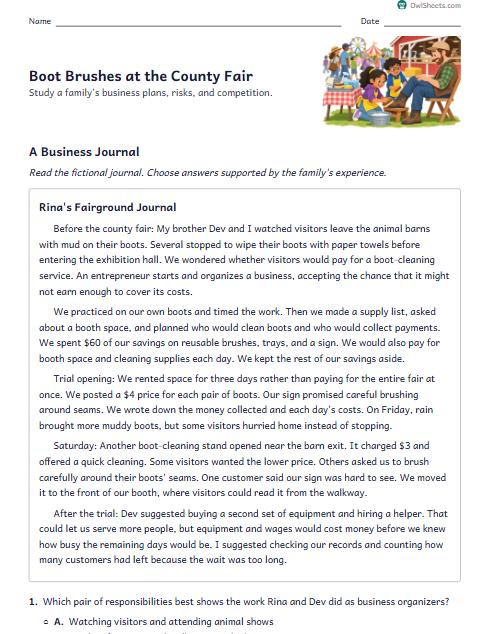
Boot Brushes at the County Fair
Grade 4 · ECO.4.3
13 questionsPremium
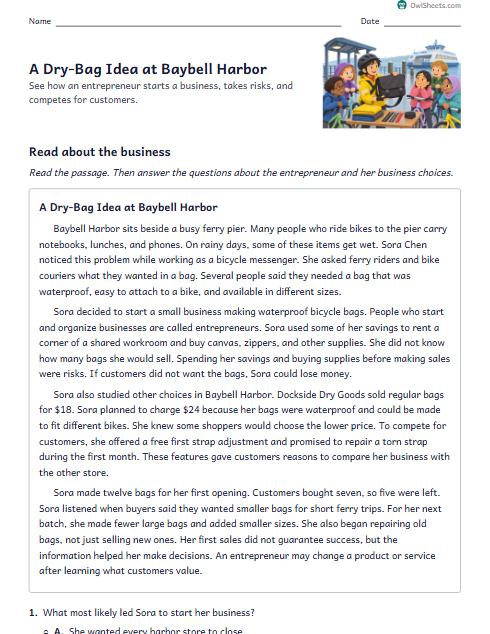
A Dry-Bag Idea at Baybell Harbor
Grade 4 · ECO.4.3
15 questionsPremium