Grade 3 · Social StudiesECO.3.3
A Weaving Plan for the History Museum
Compare a museum weaving business's goods and lessons, check production costs, and use evidence to evaluate a class's purchase.
Preview
OwlSheets.com
A Weaving Plan for the History Museum
Help a class check how a business produces its work and sets prices.
Study the class plan
Read the planning record. Use it to think about the work behind each offering.
Two Offers for One Class
Ms. Velez's class is planning a visit to Millstrand History Museum. Twelve students want to learn about handweaving. At their planning meeting, they examine two offers from Nerina's Weaving, a made-up business that works in the museum's craft room.
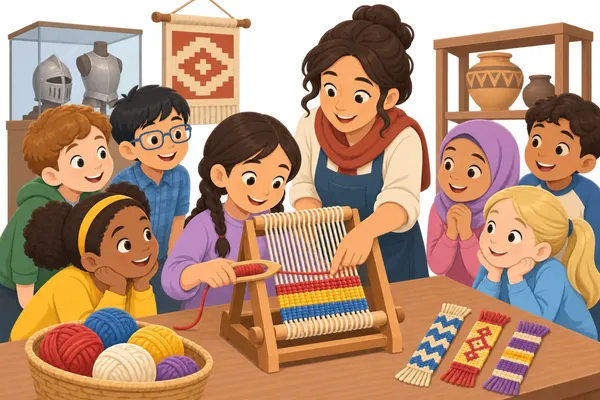
For $60, Nerina will supply an order of twelve finished woven bookmarks. She measures and cuts yarn, stretches threads on small weaving frames called looms, and weaves more yarn through them. She ties the ends and checks each bookmark before packing the order. The class receives finished goods.
For $72, Nerina will lead one weaving lesson for all twelve students. Before they arrive, she winds yarn into small bundles and tests the looms. During the lesson, she shows the steps, watches students practice, and helps them fix loose threads. Each student makes a bookmark to take home. Nerina supplies yarn and equipment, but she does not provide already-finished bookmarks for this offer.
Nerina gives the class a cost record. Worker time is a business expense, including time spent preparing before customers arrive. The equipment and room amounts are each offering's share of those expenses. The table includes all estimated costs for each whole class order or lesson. These are business expenses, not prices paid by customers. The class has not placed an order. Students agree to examine the work and the costs before choosing together.
- A. Pack the cut yarn with directions for the students.
- B. Bundle the yarn and place it beside the museum exhibits.
- C. Set out the looms and wait for students to begin weaving.
- D. Weave the yarn, secure the ends, and check the bookmarks.
- A. The class pays for yarn without help using it.
- B. The class pays to own the museum's weaving looms.
- C. The class pays for Nerina's teaching and guidance.
- D. The class pays for bookmarks Nerina has finished.
- A. The class would need fewer directions about weaving.
- B. Nerina would spend lesson time getting equipment ready.
- C. Nerina would finish the students' bookmarks before they arrive.
- D. The class would receive extra time to practice weaving.
Nerina helps students fix loose threads.Nerina winds yarn into small bundles.Nerina watches students practice.Nerina tests the looms.
Check the costs
Use the table and the planning record. Each column is for one whole order or one whole lesson for twelve students.
| Expense | 12 finished bookmarks | One class lesson |
|---|---|---|
| Yarn and supplies | $12 | $12 |
| Making bookmarks | $24 | $0 |
| Preparing lesson | $0 | $12 |
| Teaching lesson | $0 | $24 |
| Equipment and room | $12 | $12 |
- A. Include the $24 cost of teaching a lesson.
- B. Include the $12 share for equipment and room.
- C. Remove the $24 cost of making bookmarks.
- D. Replace the $12 supply cost with the $60 price.
The price for the whole lesson would be $ .
- A. Each offering leaves $12 after its estimated costs.
- B. Each offering leaves $24 after its estimated costs.
- C. The bookmark order leaves $12 more than the lesson.
- D. The lesson leaves $12 more than the bookmark order.
- A. Cover the lesson cost with nothing left.
- B. Cover the lesson cost and leave $5.
- C. Cover the lesson cost and leave $12.
- D. Fall $12 short of the lesson cost.
- A. The $42 payment would exactly cover the costs.
- B. The $42 payment would fall $12 short of costs.
- C. The $42 payment would leave $12 after costs.
- D. The $42 payment would fall $18 short of costs.
- A. $54, because the savings are greater than the added cost
- B. $48, because the supply expense is removed
- C. $60, because the two changes cancel each other
- D. $66, because checking adds worker time
- A. No. The new cost is $72, leaving a $12 gap.
- B. Yes. The new cost is $36, leaving $24.
- C. Yes. The new cost is $60, matching the price.
- D. No. The new cost is $96, leaving a $36 gap.
- A. Lesson equipment costs $24, but bookmark equipment costs $12.
- B. Lesson supplies cost $24, but bookmark supplies cost $12.
- C. Lesson worker time costs $24, but bookmark worker time costs $36.
- D. Lesson worker time costs $36, but bookmark worker time costs $24.
Explain a decision
Make a claim and support it with work details and cost calculations.
Related worksheets
A Letter About Lookout Rentals
Grade 3 · ECO.3.3
13 questionsPremium
Following the Costs at Sage Spur Ranch
Grade 3 · ECO.3.3
14 questionsPremium
Dumplings and Boot Heels on Dorsey Street
Grade 3 · ECO.3.3
14 questionsPremium
How Oakmere Bike Care Sets Prices
Grade 3 · ECO.3.3
15 questionsPremium
Prices at Foxglove County Fair
Grade 3 · ECO.3.3
14 questionsPremium
Prices at Northgate Print Studio
Grade 3 · ECO.3.3
14 questionsPremium