Grade 3 · Social StudiesHIS.3.4
Inside Hearthpin Cycle Repair
Investigate a fictional bicycle repair shop using a primary-source map, a worker's note, and a later historian's account.
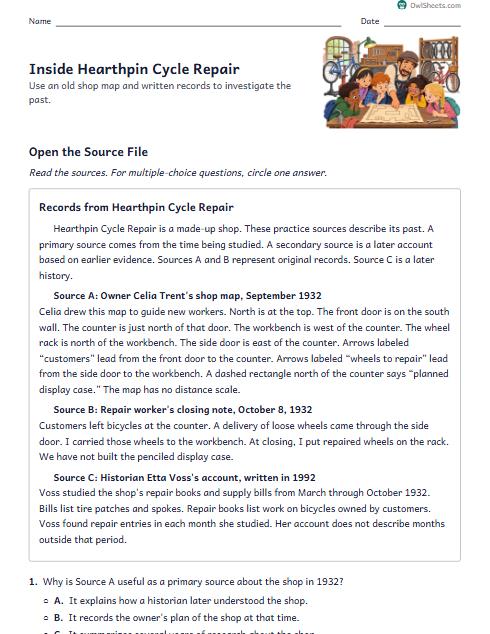
Preview
OwlSheets.com
Inside Hearthpin Cycle Repair
Use an old shop map and written records to investigate the past.

Open the Source File
Read the sources. For multiple-choice questions, circle one answer.
Records from Hearthpin Cycle Repair
Hearthpin Cycle Repair is a made-up shop. These practice sources describe its past. A primary source comes from the time being studied. A secondary source is a later account based on earlier evidence. Sources A and B represent original records. Source C is a later history.
Source A: Owner Celia Trent's shop map, September 1932
Celia drew this map to guide new workers. North is at the top. The front door is on the south wall. The counter is just north of that door. The workbench is west of the counter. The wheel rack is north of the workbench. The side door is east of the counter. Arrows labeled “customers” lead from the front door to the counter. Arrows labeled “wheels to repair” lead from the side door to the workbench. A dashed rectangle north of the counter says “planned display case.” The map has no distance scale.
Source B: Repair worker's closing note, October 8, 1932
Customers left bicycles at the counter. A delivery of loose wheels came through the side door. I carried those wheels to the workbench. At closing, I put repaired wheels on the rack. We have not built the penciled display case.
Source C: Historian Etta Voss's account, written in 1992
Voss studied the shop's repair books and supply bills from March through October 1932. Bills list tire patches and spokes. Repair books list work on bicycles owned by customers. Voss found repair entries in each month she studied. Her account does not describe months outside that period.
- A. It explains how a historian later understood the shop.
- B. It records the owner's plan of the shop at that time.
- C. It summarizes several years of research about the shop.
- D. It compares the shop with repair businesses today.
Customer arrows lead from the front door to the counter.The wheel rack is north of the workbench.Wheel-repair arrows lead from the side door to the workbench.A planned display case is north of the counter.
- A. Draw the finished case outside the side door.
- B. Move the finished case beside the wheel rack.
- C. Show it as a plan on paper, not a finished case.
- D. Label the finished case as the repair counter.
- A. Repaired wheels were stored on the rack.
- B. Repair work occurred across several months.
- C. A wheel delivery entered through the side door.
- D. Customers brought bicycles to the counter.
- A. The map lacks a scale linking drawn lengths to real distances.
- B. The map records plans rather than any existing features.
- C. The map's north arrow gives distances instead of directions.
- D. The map's customer arrows measure the length of each room.
Make Research Decisions
Use what you learned about sources to consider these new discoveries.
- A. The planned display case on Celia's map
- B. The list of supplies on one October bill
- C. The dates and entries in the original repair books
- D. The customer route marked on Celia's map
- A. A secondary source because it is a later explanation using evidence
- B. A secondary source because its subject is a small business
- C. A primary source because it includes an old date
- D. A primary source because the student read original records
- A. A list that includes bicycle tire patches
- B. A total written near the bottom
- C. A date during the spring of 1932
- D. The customer name “Hearthpin Cycle Repair”
- A. A customer's feelings about one visit
- B. A worker's explanation of a repair delay
- C. A count of the shop's completed repairs
- D. A measurement of the shop's waiting space
- A. Treat the top of the torn copy as north without checking.
- B. Compare the torn copy with the complete original map.
- C. Use the order of supplies listed on a shop bill.
- D. Use the order of actions in the worker's closing note.
Check the Evidence
Decide what the sources support. Use source letters and details in your written answers.
Place the workbench west of the counter.Paint the counter bright green.Make the wheel rack exactly six feet tall.Place the side door east of the counter.
- A. The shop name establishes the photograph's exact date.
- B. The photograph belongs to the year of Voss's account.
- C. The worker's note gives the date of this photograph.
- D. The name connects the place, but more evidence is needed to date it.
Related worksheets
News on the Covered Bridge
Grade 3 · HIS.3.4
14 questionsPremium
The Airport Baggage Record Puzzle
Grade 3 · HIS.3.4
14 questionsPremium
Clues from a Silent Movie Theater
Grade 3 · HIS.3.4
13 questionsPremium
A Diary, a Photograph, and a Map
Grade 3 · HIS.3.4
15 questionsPremium
Clues Along the First Flight Timeline
Grade 3 · HIS.3.4
15 questionsPremium
A Letter from the White City
Grade 3 · HIS.3.4
15 questionsPremium