
Worksheet
Bats Wake Up at Night
Read an article about bats and use context clues to work out science words and phrases such as nocturnal, echolocation, roost and colony.
Grade 3ELAInteractive · Printable
Aligned toRI.3.4
What’s included
- Single worksheet
- Auto-graded online
- 1 Common Core standard
- Printable answer key
- 8 questions
- Classroom-ready
Details
- Format
- Interactive · Printable
- Grade
- Grade 3
- Subject
- ELA
- Question types
- Fill in the blank, Multiple choice, Matching, Circle the answer, Short answer
About this worksheet
What students practice
- Students use context clues to work out the meaning of subject-specific words.
- Students figure out the meaning of academic words and phrases in an informational text.
- Students find the sentence in a text that explains a new word.
How to use
Read the article aloud once, then let students answer on their own. Remind them to look at the sentences near each new word for clues.
Curriculum
Common Core standard covered
Work out the meaning of general academic and subject-specific words and phrases in a text on a grade 3 topic.
Preview
OwlSheets.com
Bats Wake Up at Night
Use clues in the text to figure out new words.
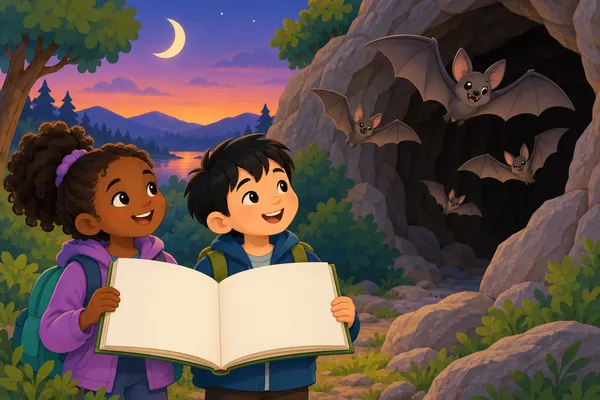
Read the article
Read the article about bats. Look for clues that help you understand new words.
Bats Wake Up at Night
1Bats are mammals that can fly. Most bats are nocturnal. They sleep through the day and wake up after dark. When the sun sets, they leave their resting places and go to search for food.
2Finding food in the dark is not easy, so many bats use echolocation. A bat makes a high squeak that people usually cannot hear. The sound travels through the air and bounces off a nearby object, such as a moth. The echo comes back to the bat's ears. From the echo, the bat can tell how far away the moth is and which way it is moving.
3During the day, a bat rests in a safe place called a roost. A roost might be a cave, a hollow tree, or a space under an old bridge. Many bats hang upside down while they rest.
4Some bats live alone, but others live in a colony. Thousands of bats may sleep side by side in one cave. Bats in a colony often huddle close, which helps keep them warm.
5Bats are helpful animals. Many bats devour insects. One small bat can eat a huge number of moths and mosquitoes in a single night. That is good news for farmers, because many insects harm crops.
Words in context
Use the article to answer each question.
- A. good at flying high
- B. able to hang upside down
- C. awake and busy at night
- D. living inside a cave
- A. finding things with echoes
- B. smelling food from far away
- C. hanging upside down to rest
- D. flying in a big group
Because bats are , they hunt for food after dark. A bat finds a moth by listening for the of its own squeak. In the daytime, the bat rests in its .
- A. a single bat that sleeps alone
- B. a cave opening where light enters
- C. a young bat learning to fly
- D. a big group that lives together
Phrases and clues
Look closely at the words around each new word or phrase.
- after dark
- bounces off
- side by side
- a huge number of
- A. next to each other
- B. when it is night
- C. very many
- D. hits something and comes back
- A. chase away from a place
- B. eat a large amount of
- C. hide from in the dark
- D. count one by one
Bats are helpful animals.Many bats devour insects.One small bat can eat a huge number of moths and mosquitoes in a single night.That is good news for farmers, because many insects harm crops.
Related worksheets
 Worksheet
Grade 3
From River to Faucet: Water Plant Words
Reading: Informational Text · RI.3.4
Premium10 questions
 Worksheet
Grade 3
Planning a Building: An Architect's Words
Reading: Informational Text · RI.3.4
Premium9 questions
 Worksheet
Grade 3
Tunnels Take Us Through
Reading: Informational Text · RI.3.2
Premium10 questions
 Worksheet
Grade 3
Sundials: Telling Time with Shadows
Reading: Informational Text · RI.3.10
Premium11 questions
 Worksheet
Grade 3
Keep Cursive in Our School: What Do You Think?
Reading: Informational Text · RI.3.6
Premium10 questions
 Worksheet
Grade 3
How a Compass Finds North
Reading: Informational Text · RI.3.1
Premium9 questions