Grade 2 · Social StudiesHIS.2.4
Words, Music, and Egg Designs
Explore Wampanoag language learning, Cajun music, and Ukrainian American egg decorating through reading and evidence-based questions.
Preview
OwlSheets.com
Words, Music, and Egg Designs
Explore three ways people express their cultures.
Read About Three Traditions
Read the passage. Circle the best answer for each question.
Culture Has Many Forms
Culture includes a group's languages, arts, music, and customs. A tradition is a practice people pass along. Across America, people express their cultures in many ways. Here are three examples. They do not describe everything about these groups.
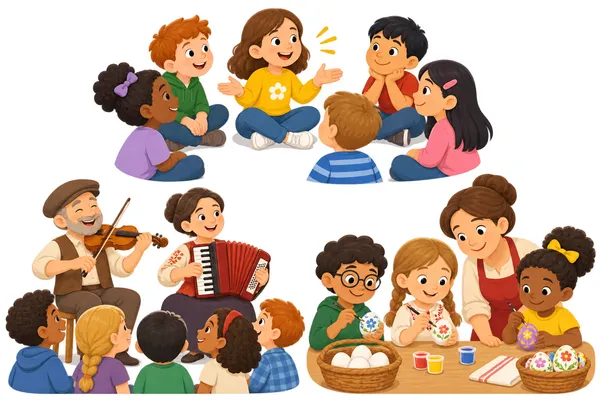
Wampanoag people are Native people whose homelands include parts of Massachusetts and Rhode Island. Wampanoag communities live there today. Some families take part in learning Wôpanâak, their people's language. Teachers and learners use words in games, songs, and everyday talk. Children can practice with other speakers instead of learning words from a page alone.
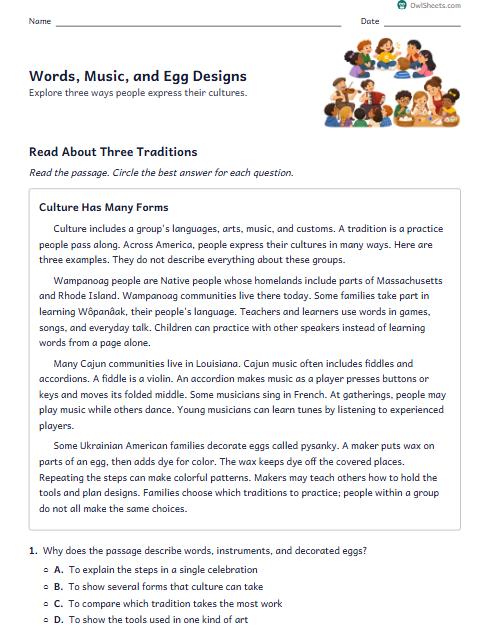
Many Cajun communities live in Louisiana. Cajun music often includes fiddles and accordions. A fiddle is a violin. An accordion makes music as a player presses buttons or keys and moves its folded middle. Some musicians sing in French. At gatherings, people may play music while others dance. Young musicians can learn tunes by listening to experienced players.
Some Ukrainian American families decorate eggs called pysanky. A maker puts wax on parts of an egg, then adds dye for color. The wax keeps dye off the covered places. Repeating the steps can make colorful patterns. Makers may teach others how to hold the tools and plan designs. Families choose which traditions to practice; people within a group do not all make the same choices.
- A. To explain the steps in a single celebration
- B. To show several forms that culture can take
- C. To compare which tradition takes the most work
- D. To show the tools used in one kind of art
- A. A Louisiana dance tradition
- B. A Cajun instrument tradition
- C. A Wampanoag language tradition
- D. A Ukrainian American design tradition
Learners use Wôpanâak in everyday talk.Wax keeps dye off covered places on an egg.An accordion has a folded middle.Young Cajun musicians listen to experienced players.
- A. Wôpanâak words are used in Cajun songs.
- B. Language practice happens apart from music.
- C. French words are used to name egg patterns.
- D. Singing can bring language into a musical tradition.
- A. To hear how a French song sounds
- B. To learn how to handle the decorating tools
- C. To practice words in a language game
- D. To learn how accordion keys move
- A. A tradition is a practice that people pass along.
- B. Culture includes languages, arts, and customs.
- C. Wampanoag communities live in their homelands today.
- D. Their homelands include parts of two states.
Use What You Learned
Use the passage to think about each new example.
- A. By dancing along with the music
- B. By playing a tune on the fiddle
- C. By pressing the accordion's keys
- D. By putting wax designs on an egg
- A. Playing a game using the words with speakers
- B. Sorting the lists by the length of each word
- C. Copying the lists onto larger sheets of paper
- D. Drawing a colorful border around each list
- A. Repeating the dye step without wax
- B. Leaving that part without wax
- C. Adding more dye to that part
- D. Covering that part with wax
Two Ukrainian American families could choose different traditions to practice.A Cajun fiddler and a pysanky maker use the same tools.A Wampanoag child could use the language in both a song and a game.These three examples describe everything about the groups' cultures.
- A. Name Cajun music separately from the Wampanoag example.
- B. Name all three examples as Wampanoag traditions.
- C. Put egg decorating under Wampanoag language.
- D. Put Cajun music under Ukrainian American art.
- A. A fiddle rests in its case beside an accordion.
- B. A learner practices a tune while a musician demonstrates it.
- C. An egg sits in a box beside decorating tools.
- D. A word list lies inside a closed notebook.
Related worksheets
Supper Notes at Cressbend Diner
Grade 2 · HIS.2.4
13 questionsPremium
A Culture Walk Near the Everglades
Grade 2 · HIS.2.4
14 questionsPremium
Listening at Windgate Music Festival
Grade 2 · HIS.2.4
13 questionsPremium
A Letter from Many Roots Day
Grade 2 · HIS.2.4
15 questionsPremium
Threads Through Time
Grade 2 · HIS.2.4
15 questionsPremium
Culture Cards: Then and Now
Grade 2 · HIS.2.4
15 questionsPremium