OwlSheets.com
Community Garden Beds: Counting Square Units
Count the unit squares that cover each garden bed to find its area.
Answer Key
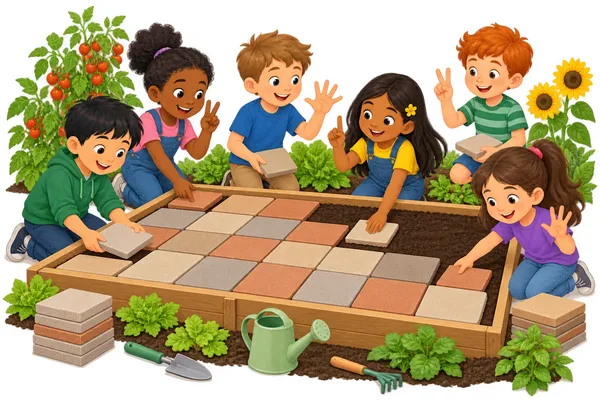
The garden map
This map shows the beds in the community garden. Each small square is 1 square unit. Count the unit squares that cover each bed.
Bed A is covered by 6 unit squares, so its area is 6 square units.
9 square units
7 square units
- A. Bed C
- B. Bed D
- C. Bed E
- D. Bed B
- A. Bed A and Bed F
- B. Bed B and Bed D
- C. Bed C and Bed E
- D. Bed D and Bed F
| Less than 10 square units | Exactly 10 square units | More than 10 square units |
|---|---|---|
Bed A Bed D Bed F | Bed C Bed E | Bed B |
Think about area
Use what you know about unit squares to answer each question.
- A. Bed A, because it is wider.
- B. Bed F, because it is covered by 7 unit squares and Bed A is covered by 6.
- C. They cover the same amount of ground because both are rectangles.
- D. Bed A, because it has more rows.
14 square units
- A. The gaps are part of the bed too, so it takes more than 9 unit squares to cover the whole bed.
- B. The tiles should overlap so they cover more of the bed.
- C. Area means counting the sides of the bed, not the tiles.
The herb bed has an area of 15 square feet.
Plan new beds
Each small square is 1 square unit. Shade whole squares, with no gaps and no overlaps.
Sample answer:
Any bed made of exactly 8 unit squares is correct, such as 2 rows of 4 squares.
Sample answer:
For example, 2 rows of 6 squares and 3 rows of 4 squares. Each bed is covered by 12 unit squares.
Each bed is covered by 10 unit squares with no gaps or overlaps, so each has an area of 10 square units. The shapes are different, but the number of unit squares is the same.