Compare island workers, consumers and ways to exchange goods.
Read the island note
Listen as your teacher reads the note. Then answer the questions about the two villages.
A Note from Driftwood Island
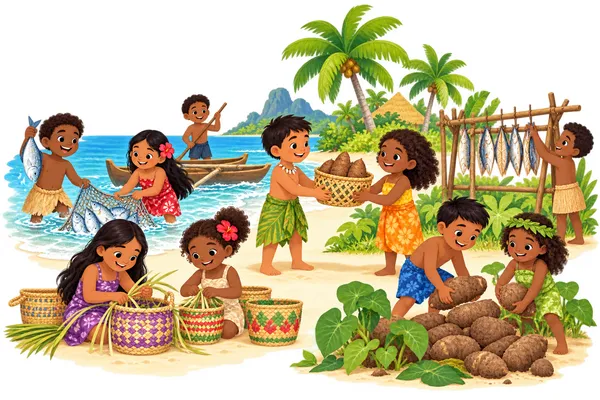
Dear Jo, I live on Driftwood Island. Two villages help one another, but their work is different. At Palm Bay, Suri catches fish. Her uncle makes wooden drying racks. At Hill Garden, Mateo grows yams, and Lani weaves baskets. These workers are producers because they gather or make goods.
People are consumers when they use goods. Families in Palm Bay eat yams, and families in Hill Garden eat fish. People can trade with shell coins, which are used as money. They can also barter. In barter, people exchange goods without money. Suri needs a basket to carry fish, and Lani needs fish for dinner. Suri gives fish to Lani, and Lani gives a basket to Suri. Each person gets something needed.
1.
What is the note mostly about?
○A.How to build drying racks
○B.How two villages make, use and exchange goods
○C.Why Palm Bay has more families
○D.How to grow yams in sand
2.
Match each place to the work or use described in the note.
Palm Bay●
Hill Garden●
Both villages●
●A.Families eat food from the other village
●B.Suri catches fish and her uncle makes drying racks
●C.Mateo grows yams and Lani weaves baskets
3.
Which comparison of the two villages is supported by the note?
○A.Both places grow yams.
○B.Palm Bay uses shell coins, but Hill Garden does not.
○C.Hill Garden catches fish, and Palm Bay weaves baskets.
○D.Palm Bay catches fish, but Hill Garden grows yams.
4.
Word bank: producer · consumer · barter · shell coins
A person who gathers or makes goods is a .
5.
Which action in the note shows someone consuming a good?
○A.Lani weaves a basket.
○B.Mateo grows yams.
○C.Suri catches fish.
○D.A family eats fish for dinner.
Ways people exchange goods
Use the note to think about barter and trade with money.
6.
Why is Suri's exchange with Lani barter?
○A.They both use shell coins.
○B.They exchange goods without shell coins.
○C.They live and work in the same village.
○D.They are both consumers and not producers.
7.
Word bank: producer · consumer · barter · shell coins
When people exchange goods without money, they .
8.
Circle the two details that show Suri and Lani's exchange helps both people.
Suri needs a basket to carry fish.Lani needs fish for dinner.Suri uses shell coins.Mateo grows yams.
9.
A family gives shell coins to Lani for a basket. What kind of exchange is this?
○A.Trade with money
○B.Barter
○C.Making a basket
○D.Growing a good
10.
Suri has fish but no basket. Lani has a basket but no fish. What can happen?
○A.Suri gives fish and gets no item.
○B.They stop being producers.
○C.They exchange fish for a basket.
○D.Lani gives yams for a drying rack.
11.
Match each word to its meaning.
Producer●
Consumer●
Barter●
Trade with money●
●A.A person who uses goods
●B.An exchange of goods without money
●C.A person who makes or gathers goods
●D.Giving coins to get a good
Use the idea
Answer the new examples. Then explain your thinking.
12.
Which person is acting as a consumer?
○A.A basket weaver makes a basket.
○B.A fisher catches fish.
○C.A rack maker builds a rack.
○D.A child eats a yam.
13.
Which sentence correctly compares barter and trade with money?
○A.Barter exchanges goods, while trade with money uses shell coins.
○B.Barter uses shell coins, while trade with money uses no money.
○C.Both ways need people to make their own goods.
○D.Both ways mean people keep the goods they have.
14.
Use the note. Explain how Suri and Lani are each a producer and a consumer. Name one thing each makes or gathers and one thing each uses.
15.
Imagine you have extra yams and need a wooden drying rack. Explain one fair way to get the rack. Tell what you would give and what you would get.